Courage and Silence
Roger S. Keyes · 1982
A Study of the Life and Color Woodblock Prints of Tsukioka Yoshitoshi 1839–1892. Series 223.THE SERIES COLLECTION · KEYES 223
魁題 百 撰相
Kaidai hyaku sensō
A series depicting historical warriors and episodes from Japanese history.
THE COMPLETE SERIES
Hover to view details. Select a print to open its image and description.
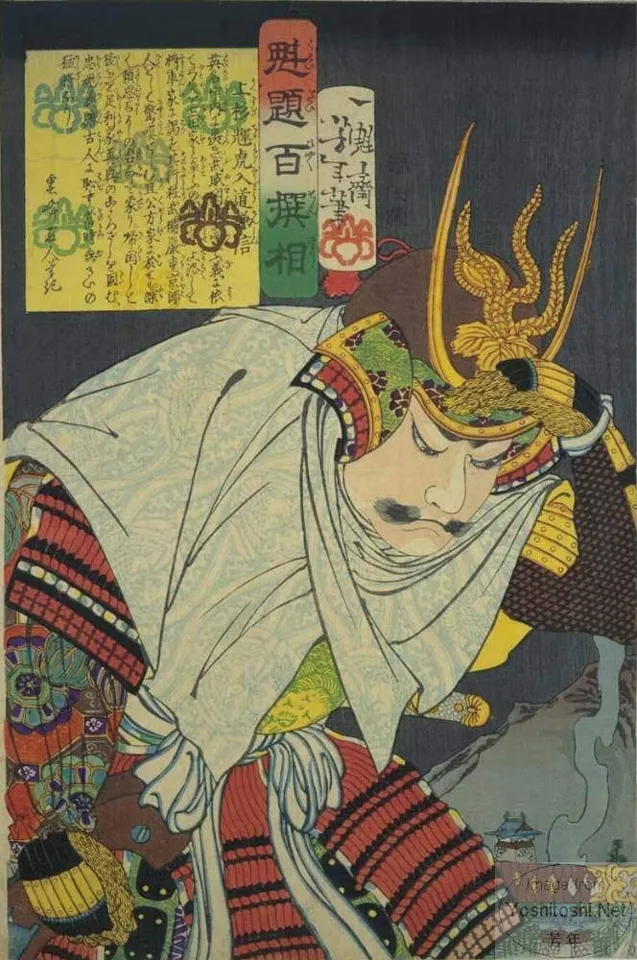
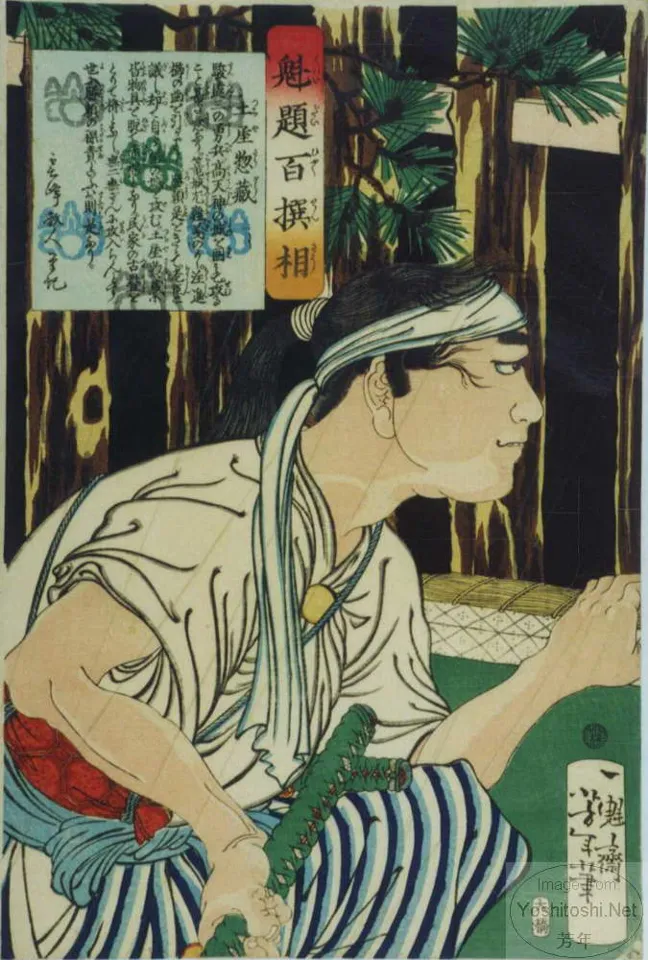 土屋 惣藏The last character of his name is usually written 蔵 now.VIEW PRINT ↗01Tsuchiya Sōzō7/1868上杉 輝虎 入道 謙信Shown in a battle helmet, he is normally known simply as Uesugi Kenshin.VIEW PRINT ↗02Uesugi Terutora Nyūdō Kenshin8/1868
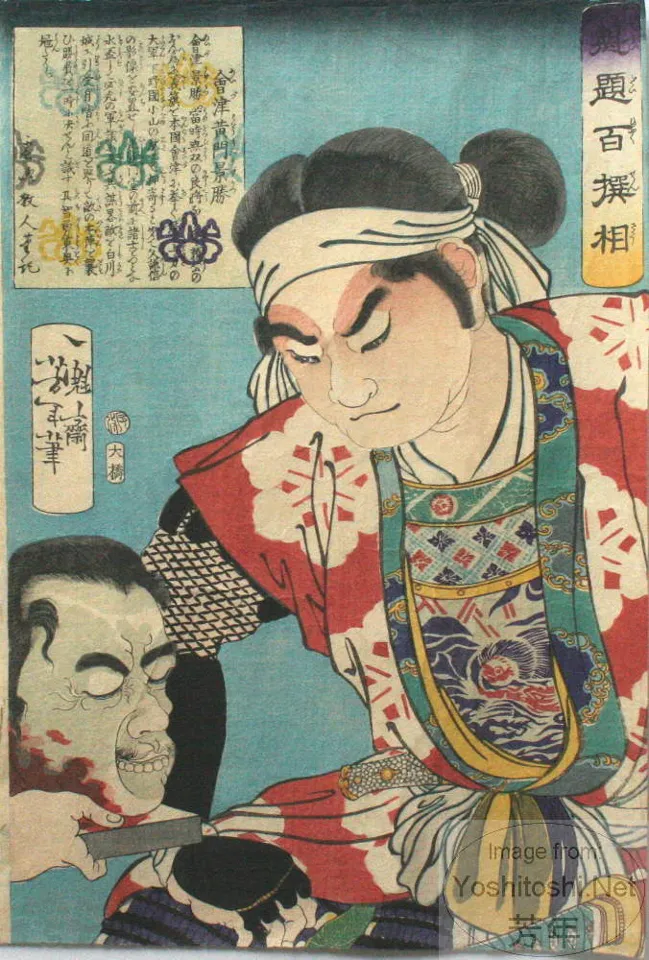 會津 黄門 景勝Shown examining a head, he is normally known as Uesugi Kagekatsu.VIEW PRINT ↗03Aizu Kōmon Kagekatsu8/1868
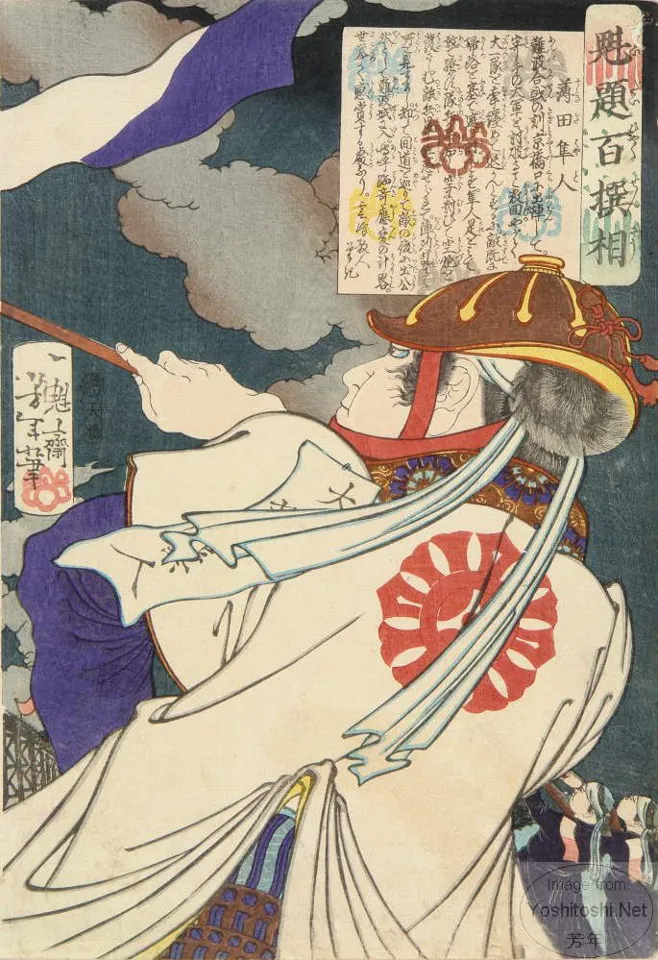 薄田 隼人Shown here signalling with a flag, he participated in the Winter and Summer Campaigns at Ōsaka Castle, on the side of the Toyotomi, the so-called 'Western' side (the Tokugawa being known as the 'Eastern' side).VIEW PRINT ↗04Susukida Hayato8/1868
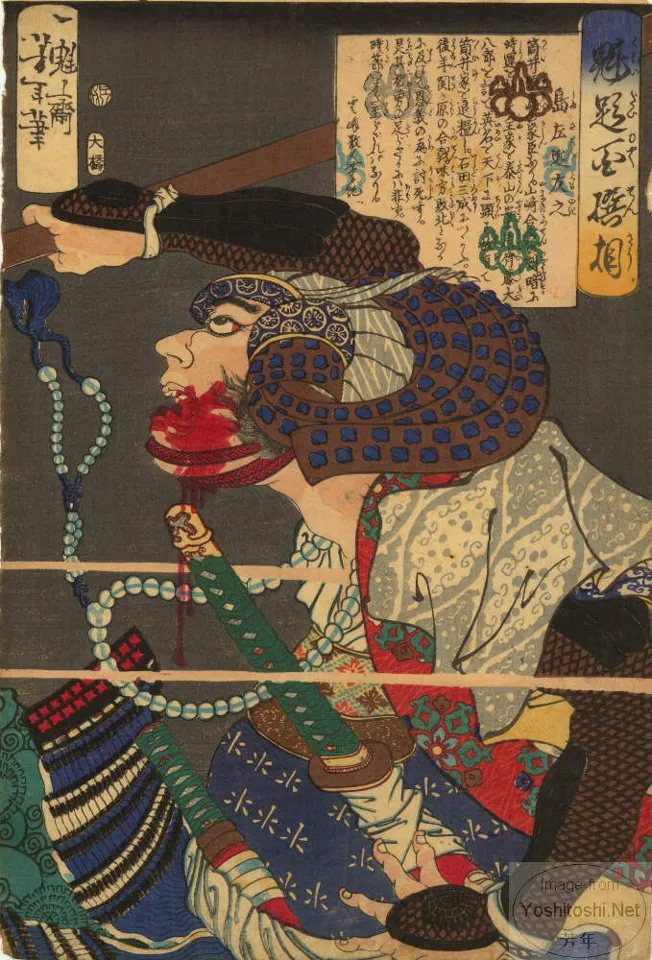 島 左近 友之Normally known as Shima Sakon, he is shown here at the Battle of Sekigahara being hit by bullets, with his juzu (rosary) swinging in the air.VIEW PRINT ↗05Shima Sakon Tomoyuki8/1868
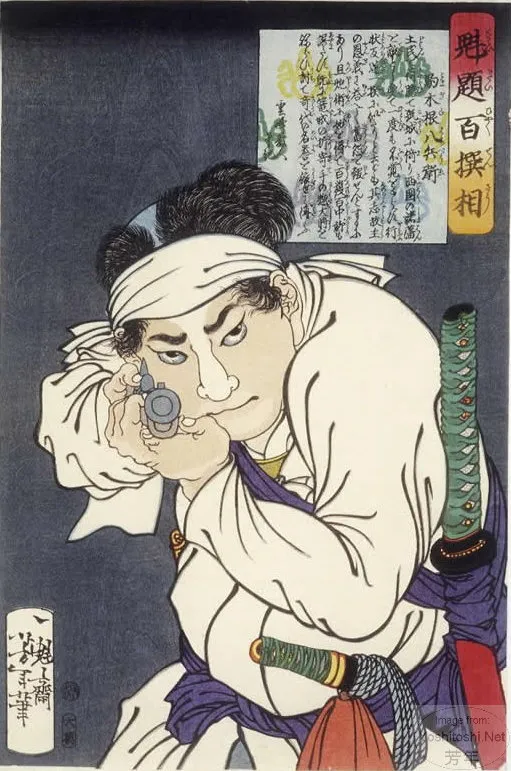 駒木根 八兵衛Komagine HachibyōeVIEW PRINT ↗06Komagine Hachibyōe8/1868
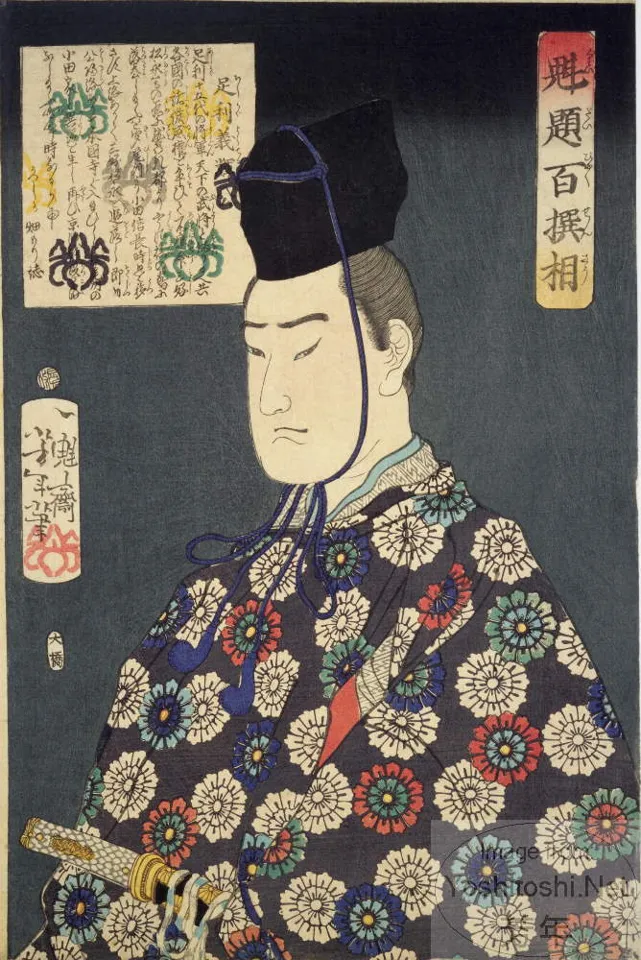 足利 義輝公Ashikaga Yoshiteru wearing a ceremonial cap and court robe.VIEW PRINT ↗07Ashikaga Yoshiteru-kō9/1868
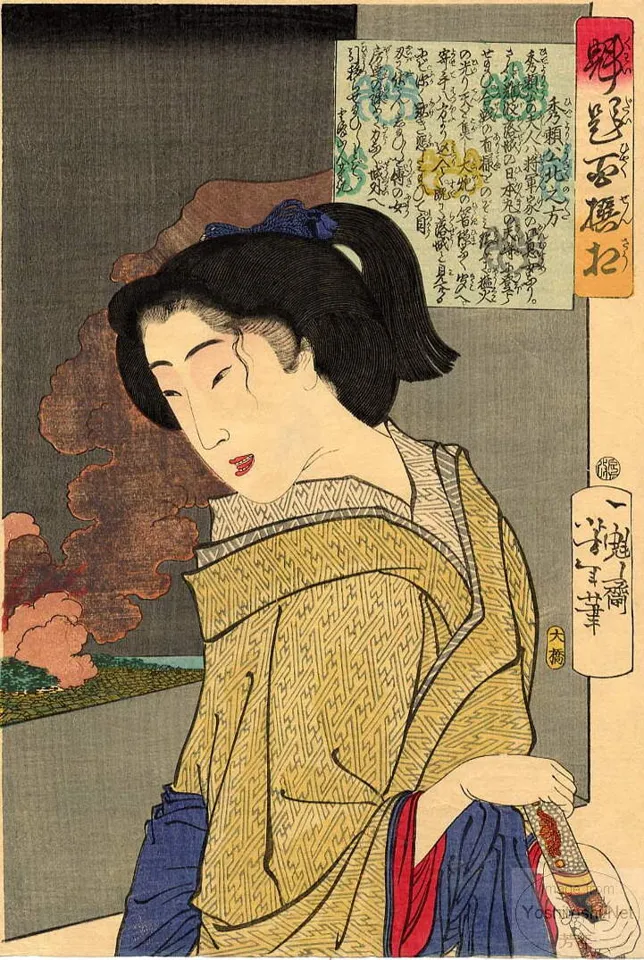 秀頼公 北之方Hideyori's consort Kita-no-Kata standing by a window; given the fire and smoke in the background, this scene is probably the firing of Osaka Castle at the end of the Winter and Summer Campaigns.VIEW PRINT ↗08Hideyori-kō Kita-no-Kata9/1868
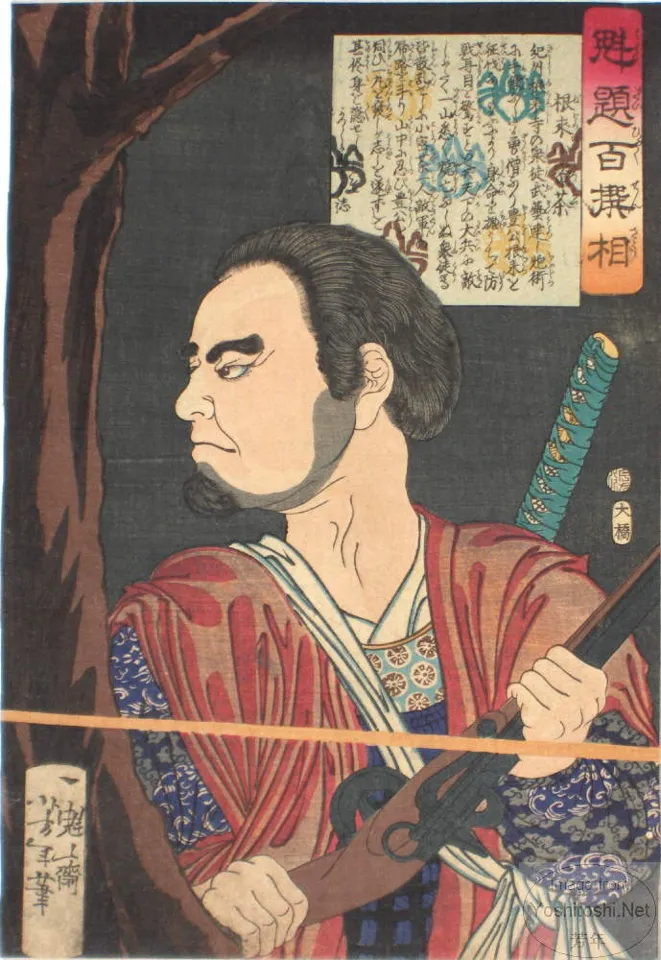 根來 小密茶The Negoro-gumi were a order of warrior monks. The second character is usually 来 nowVIEW PRINT ↗09Negoro no Komitsucha9/1868
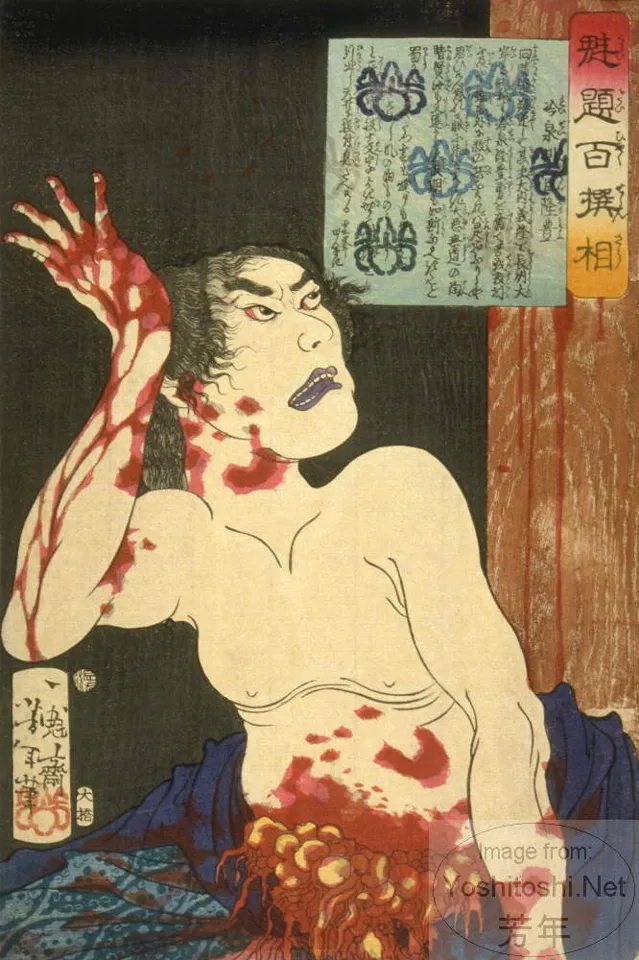 冷泉 判官 隆豊Normally known as Reizei Takatoyo, he is shown here dying from seppuku (ritual self-disembowelment).VIEW PRINT ↗10Reizei Hangan Takatoyo9/1868
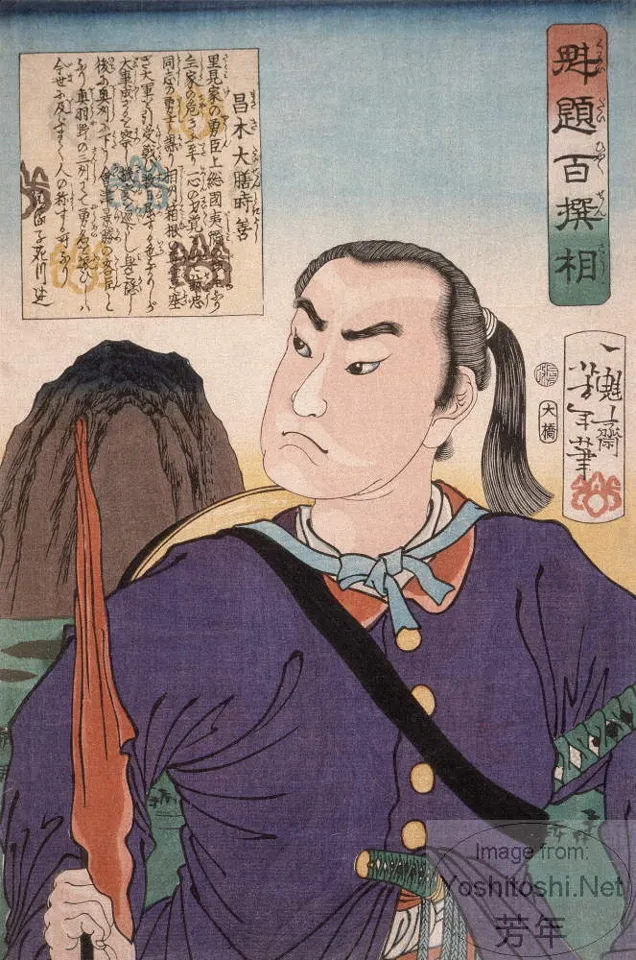 昌木 大膳 時善Masaki Taizen TokiyoshiVIEW PRINT ↗11Masaki Taizen Tokiyoshi9/1868
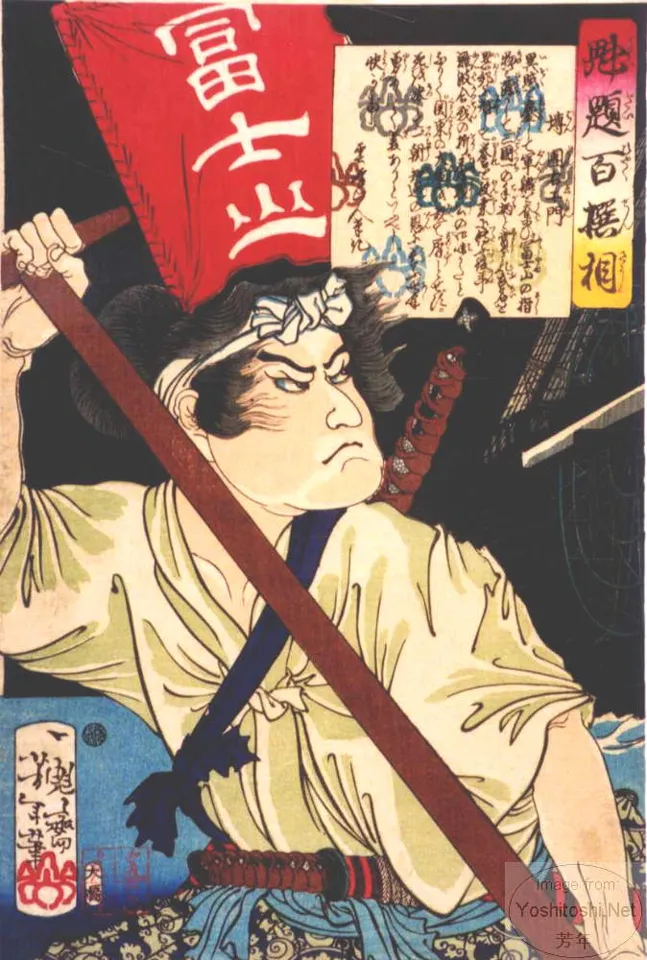 塼 團右エ門Shown rowing beside a steamship, he was better known as Ban Naoyuki.VIEW PRINT ↗12Ban Dan'emon9/1868
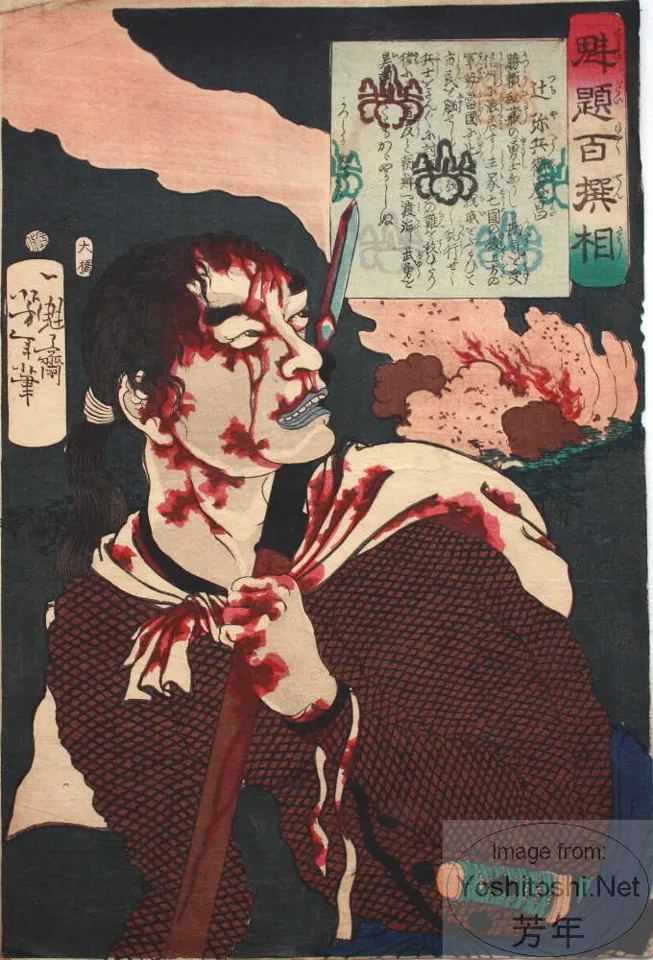 辻 弥兵衛 盛昌He was a retainer of Takeda Katsuyori; he was involved in the latter's attempt to escape after his defeat at the Battle of Temmokuzan, although there is still debate as to whether or not he turned on his master on that last day.VIEW PRINT ↗13Tsuji Yahei Morimasa9/1868
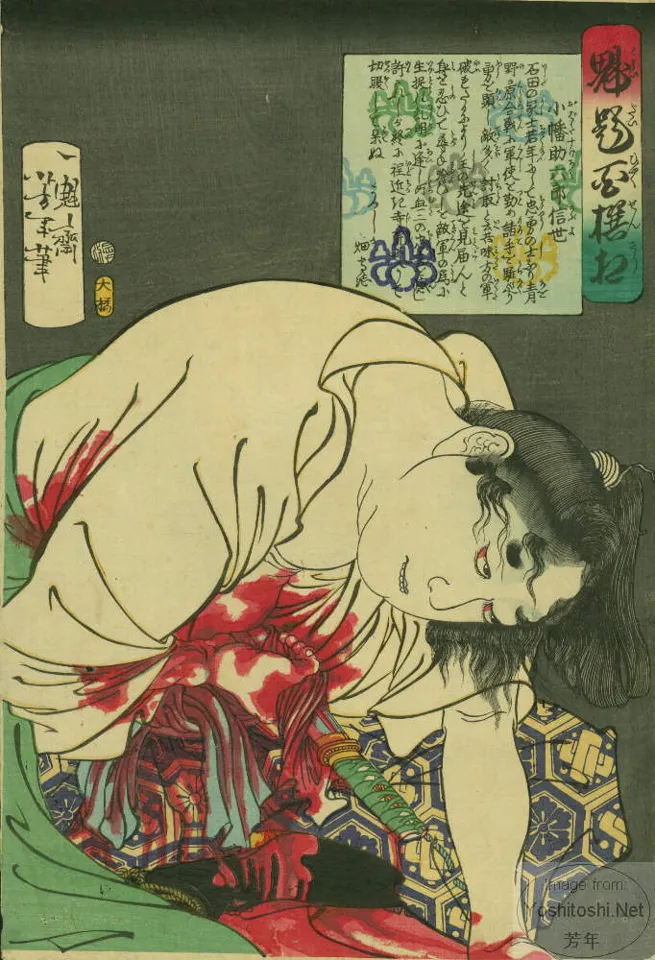 小幡 助六郎 信世Obata Sukerokurō Nobuyo commits seppuku at Omiji temple.VIEW PRINT ↗14Obata Sukerokurō Nobuyo commits seppuku at Omiji temple.9/1868
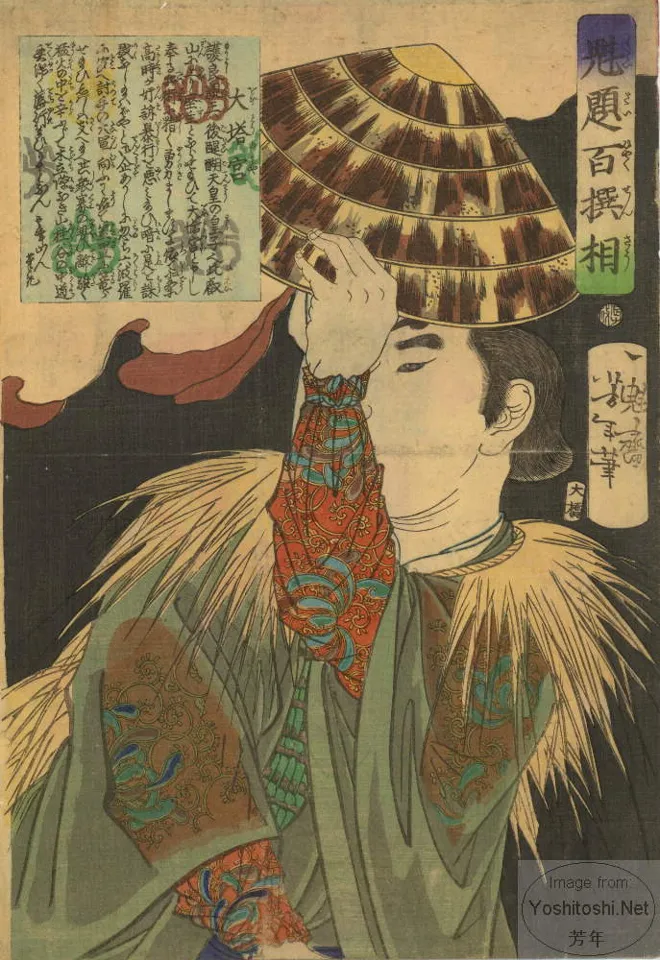 大塔 宮Ōtō no Miya (Morinaga Shinno), son of Emperor Go-Daigo, lifting a sedge hat over his headVIEW PRINT ↗15Ōtō no Miya (Morinaga Shinno), son of Emperor Go-Daigo, lifting a sedge hat over his head10/1868
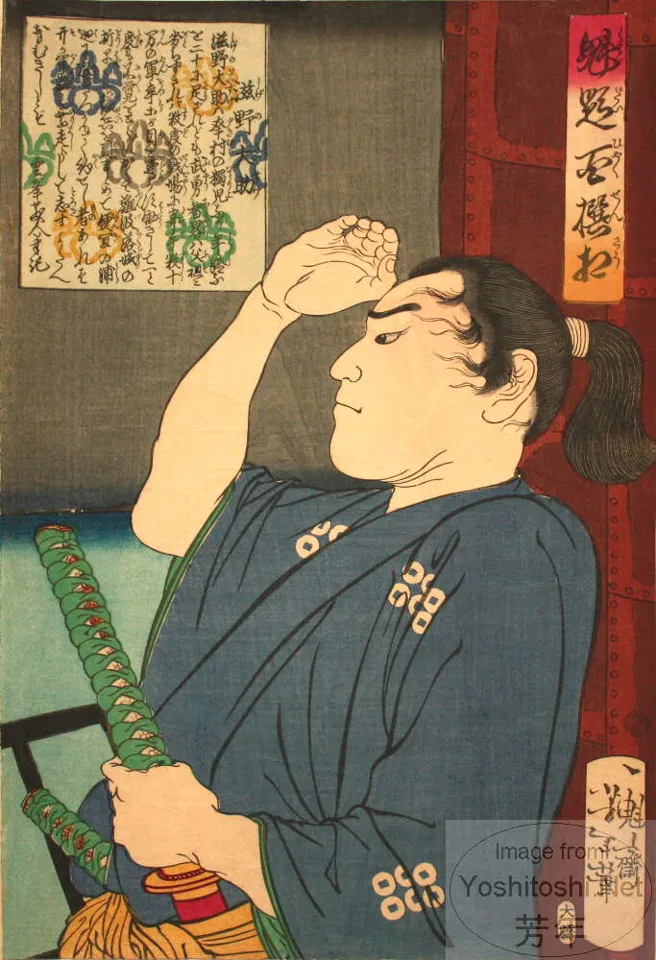 滋野 大助Shigeno Daisuke raising hand to browVIEW PRINT ↗16Shigeno Daisuke raising hand to brow10/1868
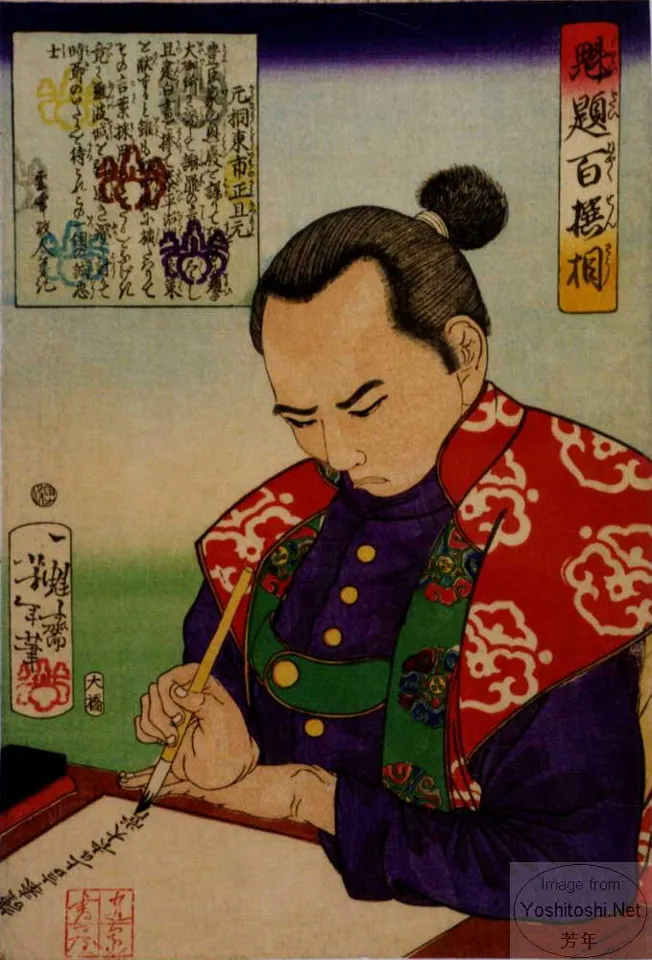 元桐 東市 正 且元Katagiri Tōichi no Kami Katsumoto writing a documentVIEW PRINT ↗17Katagiri Tōichi no Kami Katsumoto writing a document10/1868
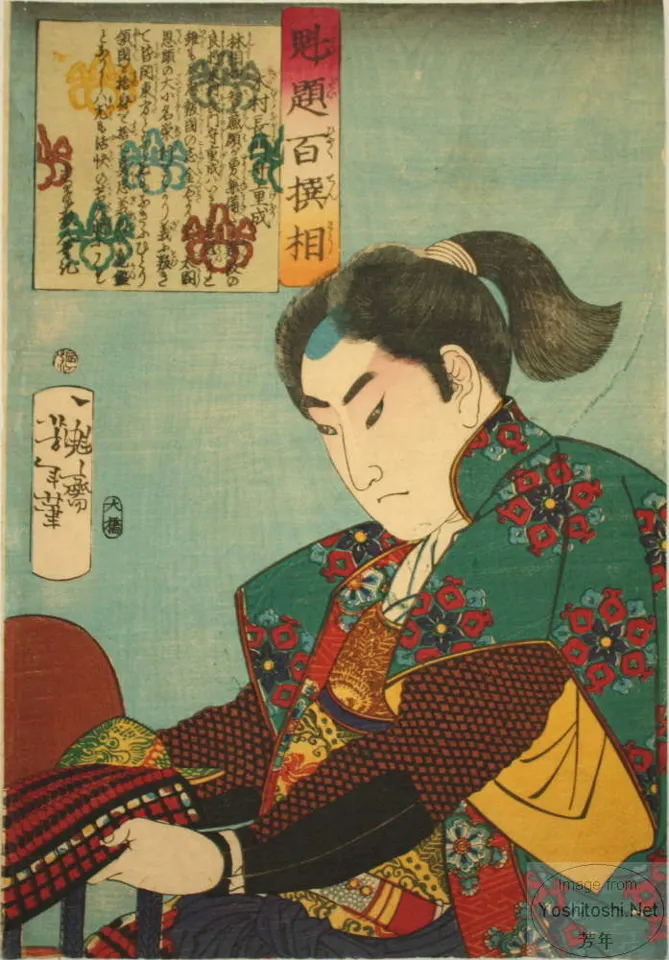 木村 長門 守 重成Kimura Nagashito no Kami Shigenari examining a helmetVIEW PRINT ↗18Kimura Nagashito no Kami Shigenari examining a helmet10/1868
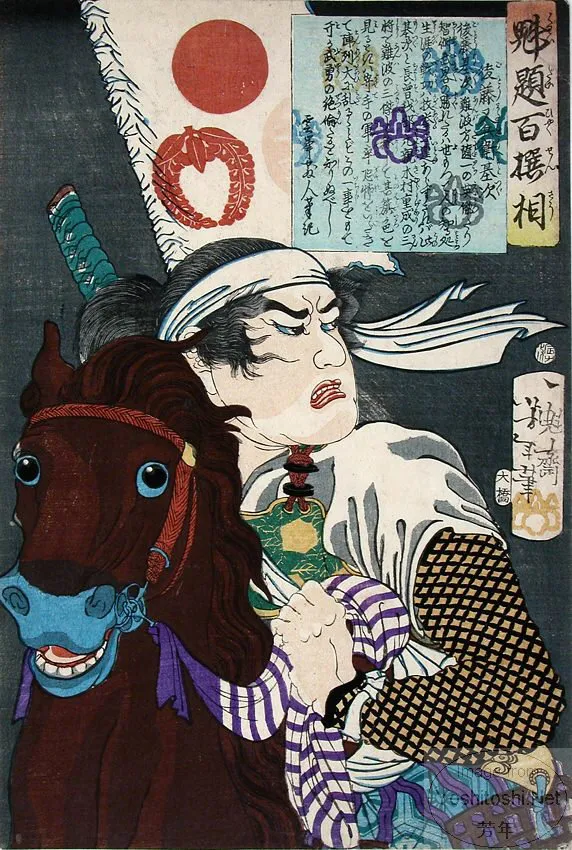 後藤 又兵衛 基次Gotō Matabei Mototsugu on horseback with banner of Naitō Masanaga.VIEW PRINT ↗19Gotō Matabei Mototsugu on horseback with banner of Naitō Masanaga.10/1868
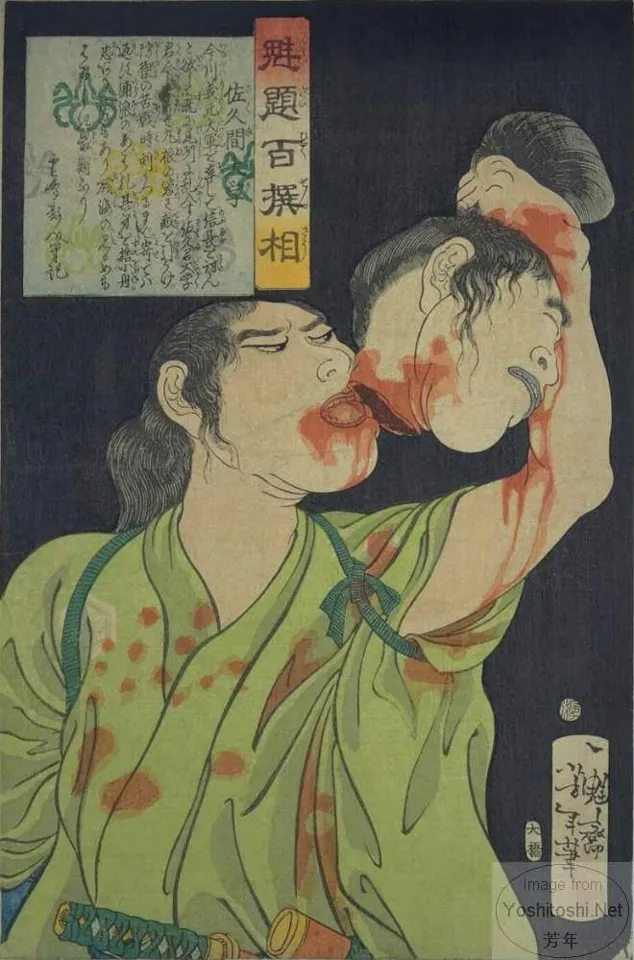 佐久間 大学Sakuma Daigaku drinking blood from a severed headVIEW PRINT ↗20Sakuma Daigaku drinking blood from a severed head10/1868
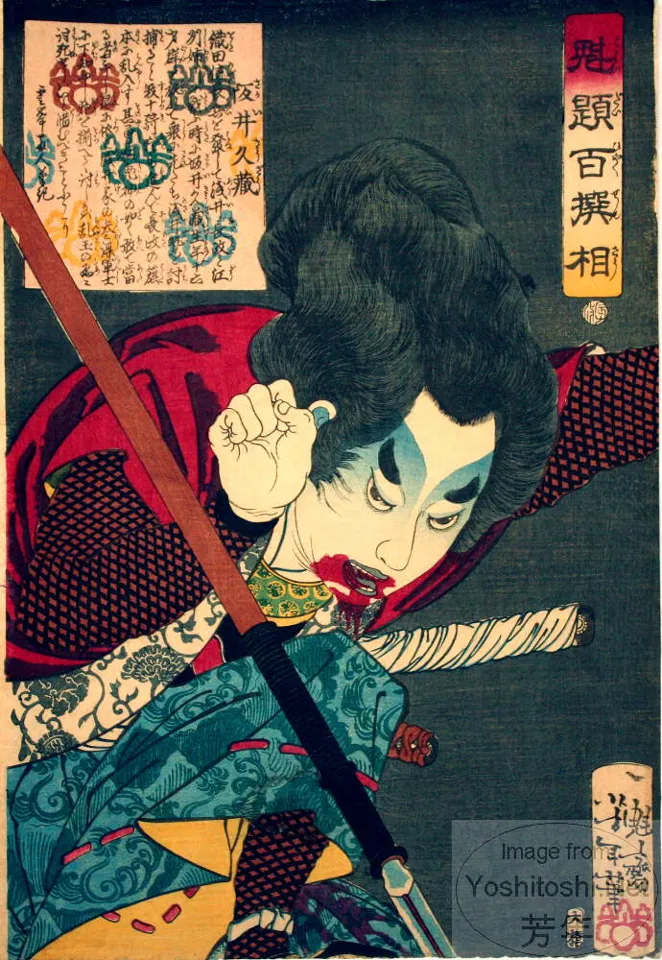 阪井 久藏Sakai Kyuzō hurling a spearVIEW PRINT ↗21Sakai Kyuzō hurling a spear10/1868
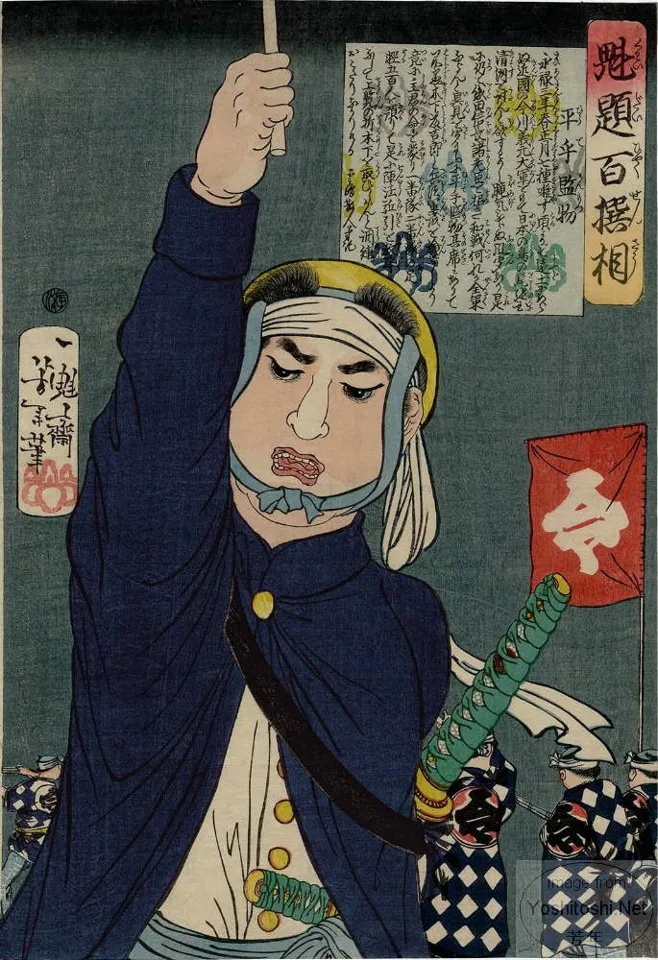 平手 監物Hirate Kenmotsu raising a batonVIEW PRINT ↗22Hirate Kenmotsu raising a baton10/1868
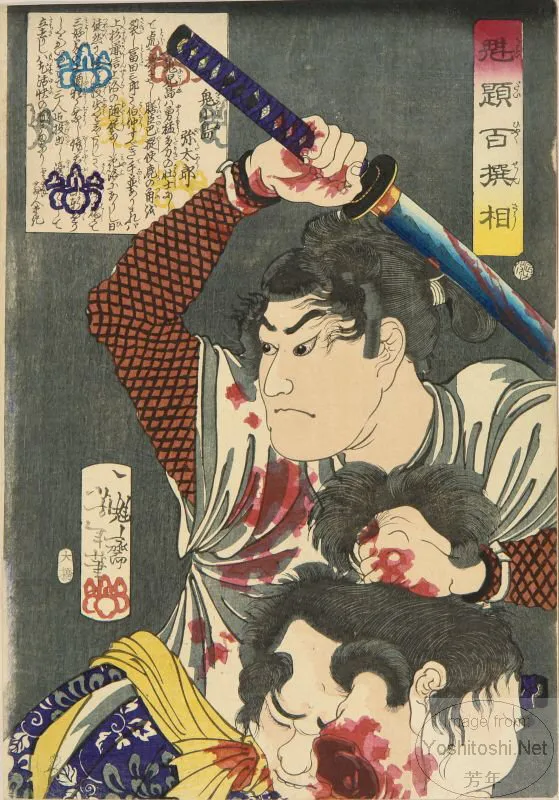 鬼小島 弥太郎Yatarō was an Uesugi warrior.VIEW PRINT ↗23Onikojima Yatarō with two severed heads and sword.10/1868
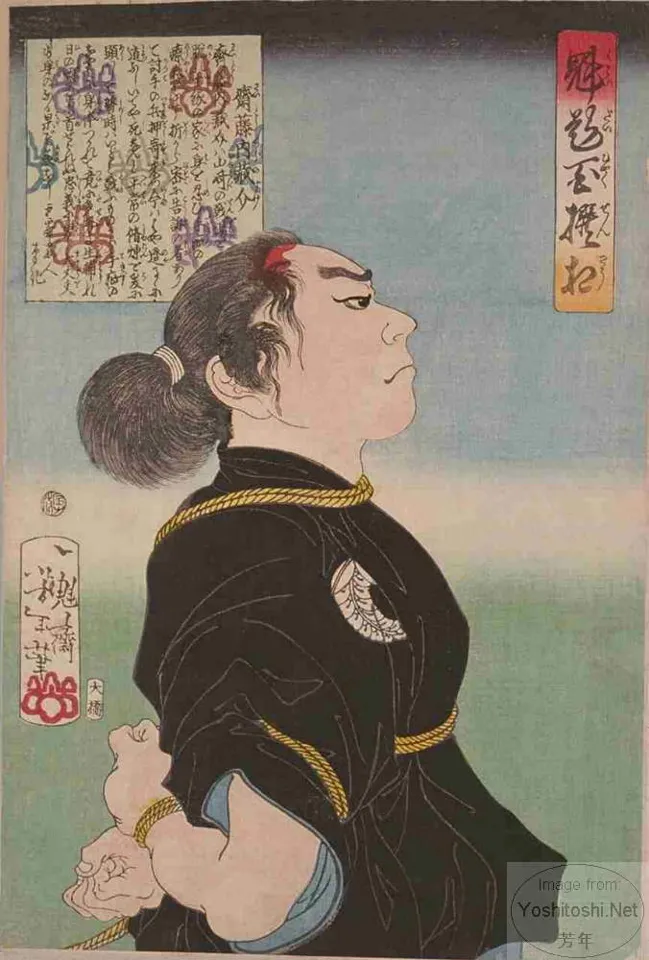 齋藤 内 藏介Saitō Kuranosuke bound with ropeVIEW PRINT ↗24Saitō Kuranosuke bound with rope10/1868
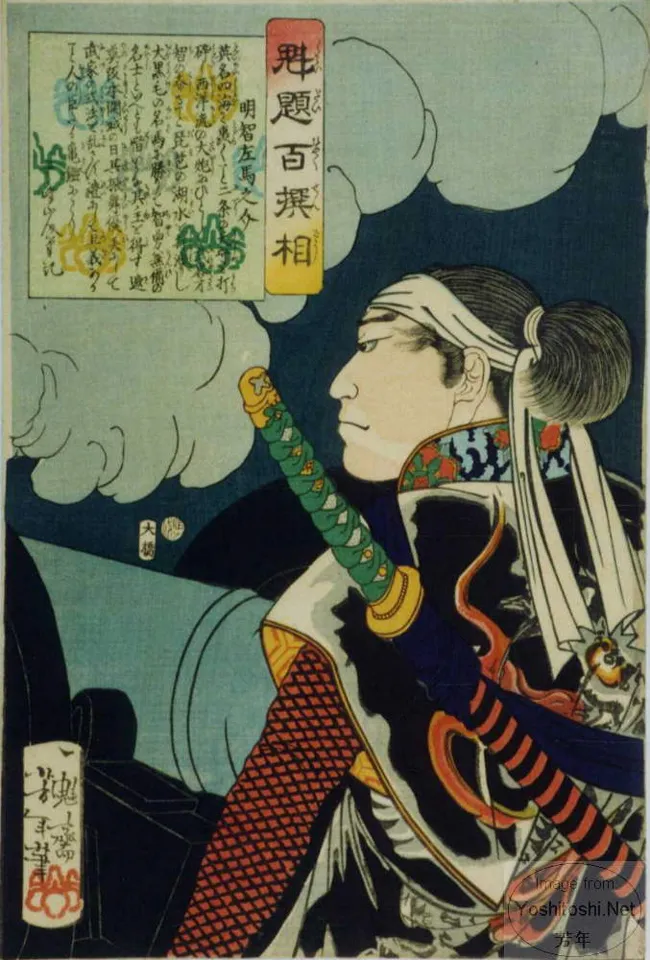 明智 左馬之介Akechi Samanosuke beside a cannonVIEW PRINT ↗25Akechi Samanosuke beside a cannon10/1868
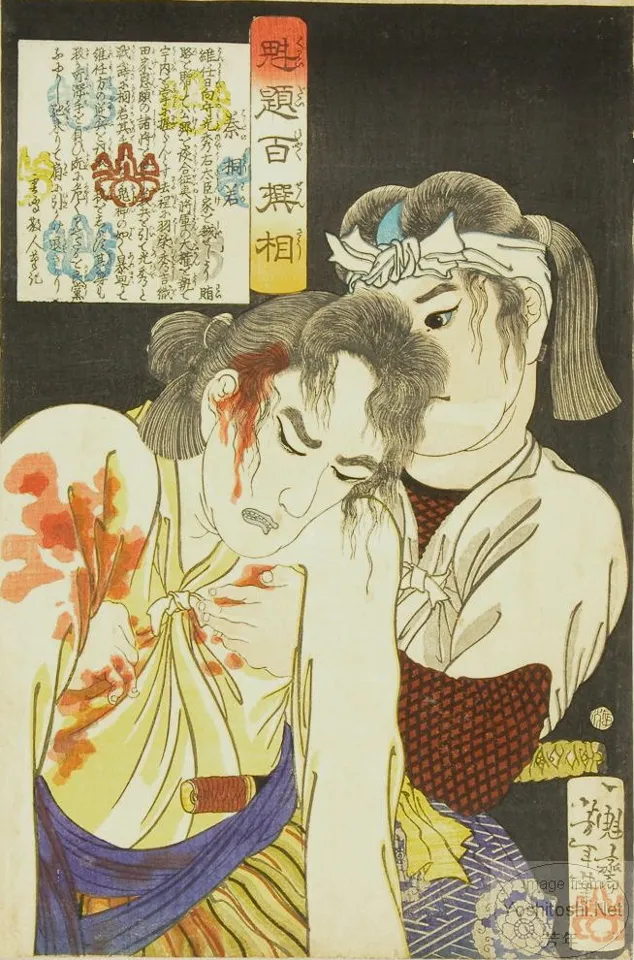 秦 桐若Hata no Kiriwaka supporting a comradeVIEW PRINT ↗26Hata no Kiriwaka supporting a comrade10/1868
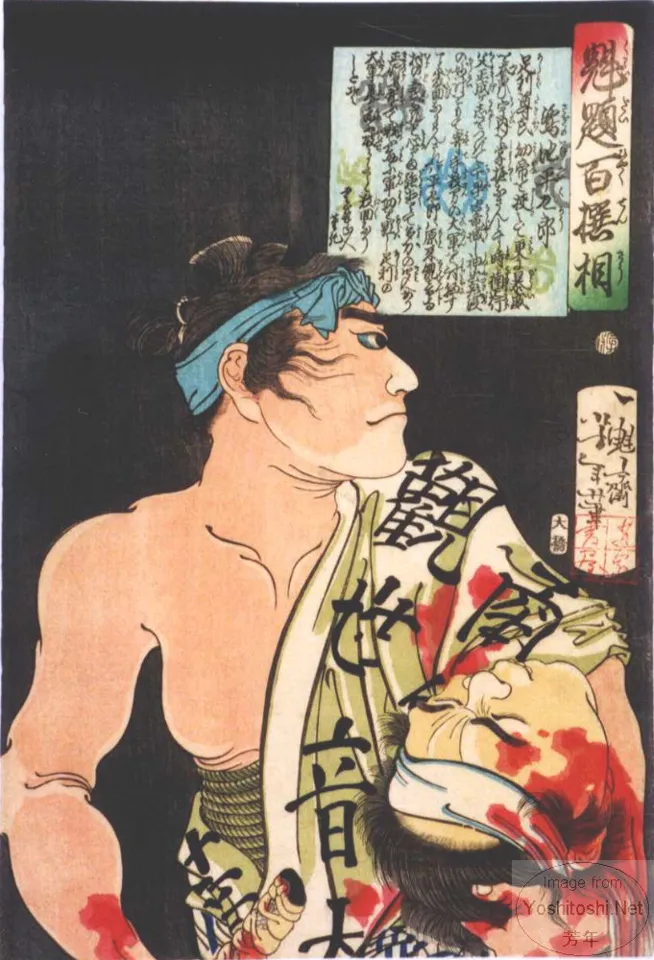 鷺 池 平九郎He was a retainer of the Kusunoki family, renowned for his strength.VIEW PRINT ↗27Sagino Ike Heikurō holding a severed head10/1868
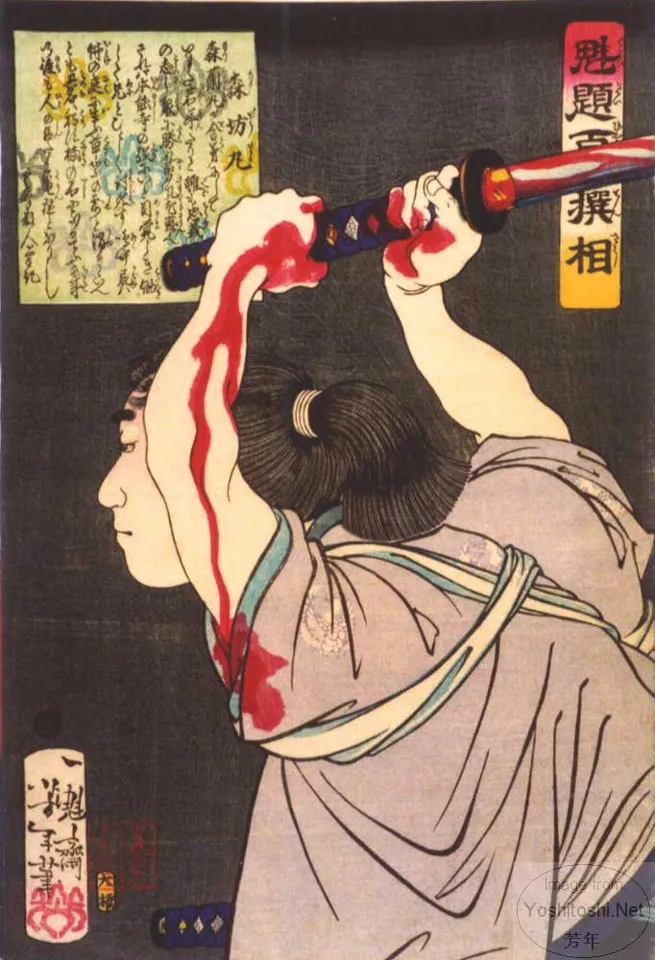 森 坊丸He is shown facing left, with a sword raised over his head.VIEW PRINT ↗28Mori Bōmaru11/1868
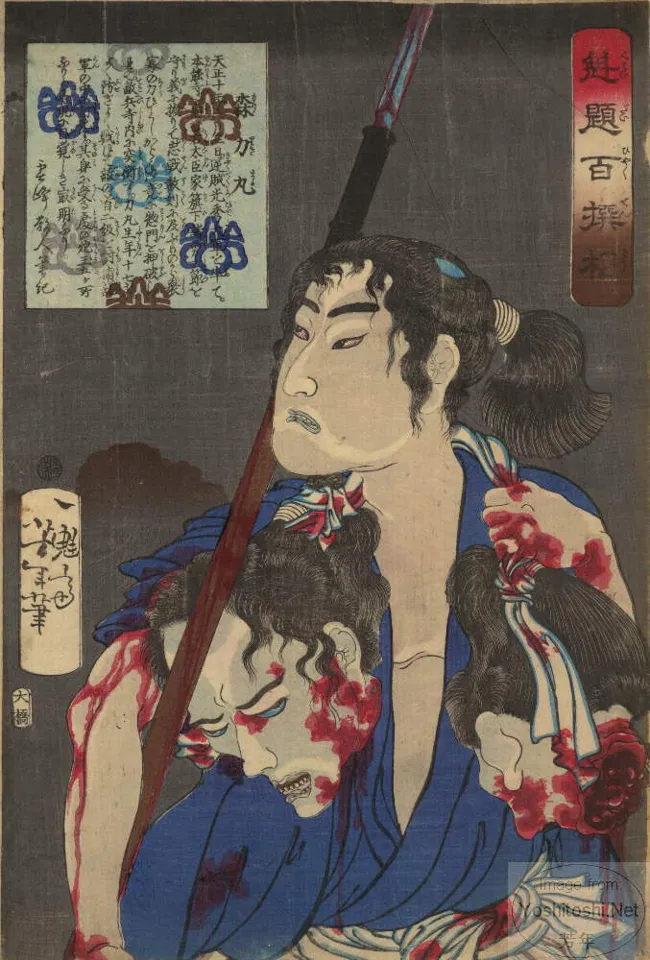 森 力丸He is shown holding an upright spear, and a pair of severed heads.VIEW PRINT ↗29Mori Rikimaru11/1868
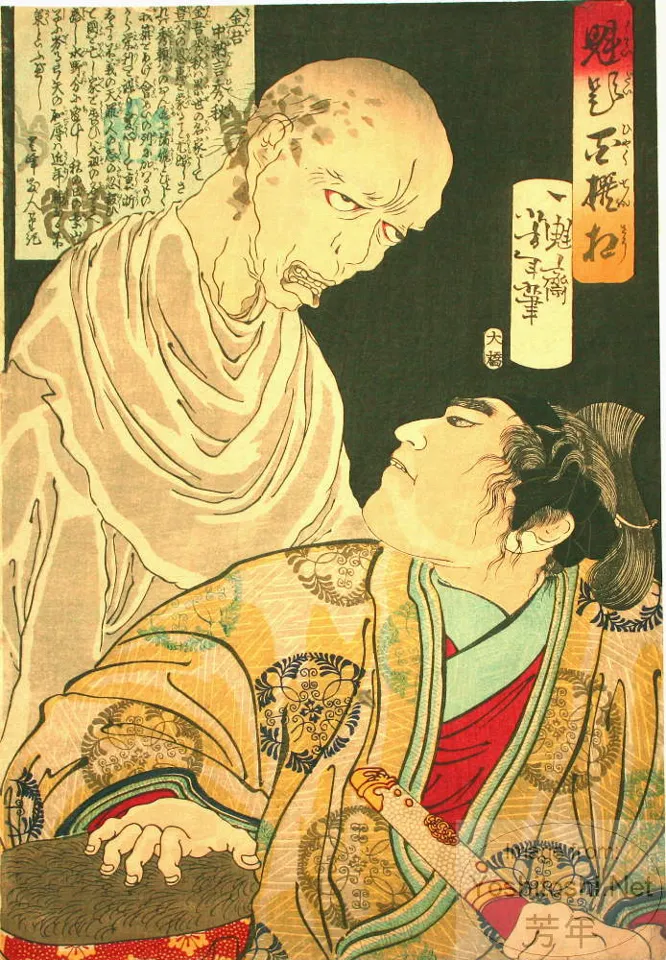 金吾 中納言 秀秋Normally known as Kobayakawa Hideaki, the Chūnagon was his rank ('middle counselor') at the Imperial Court. He is shown here looking up at a ghost. This print is known in two distinctly different colour schemes (see images).VIEW PRINT ↗30Kingo Chūnagon Hideaki12/1868
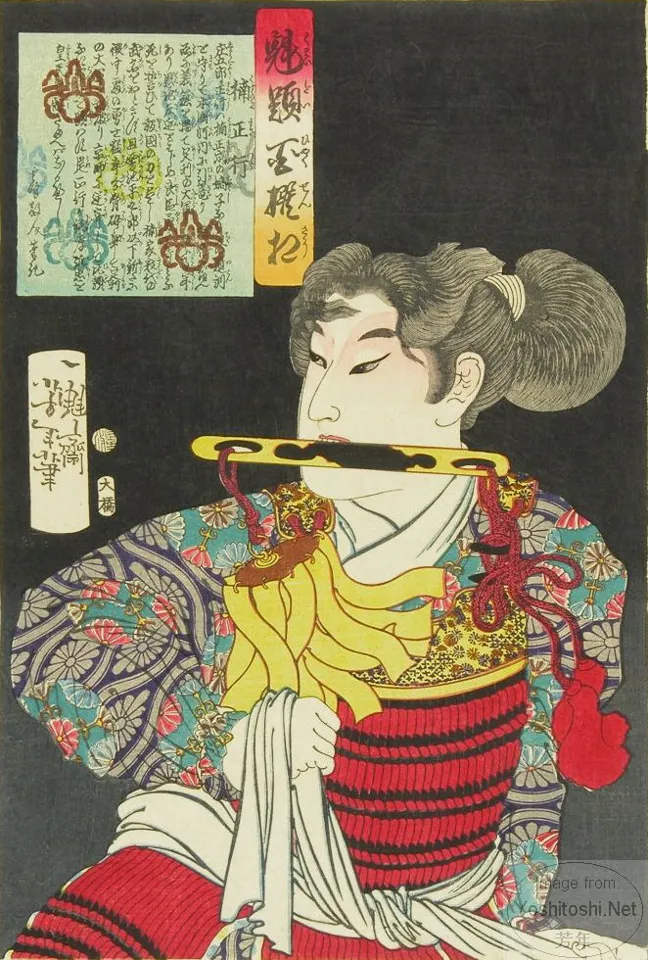 楠 正行Kusunoki Masatsura, eldest son of Masashige, tightening armor with sash.VIEW PRINT ↗31Kusunoki Masatsura, eldest son of Masashige, tightening armor with sash.12/1868
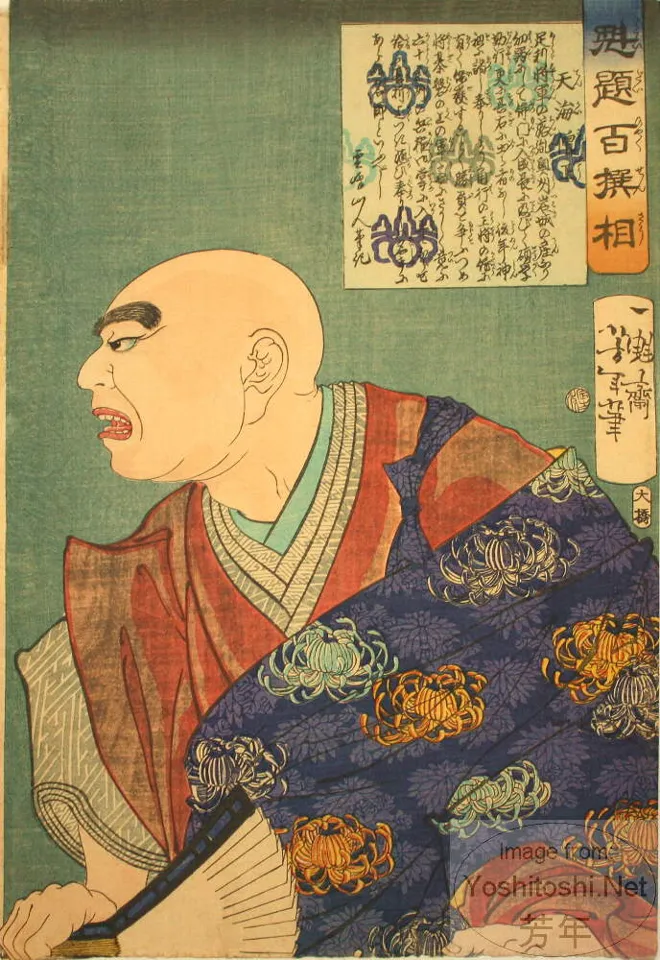 天海 僧正Tenkai was a priest; he died in 1643 at the age of 108. This print is also known in two distinctly different colour schemes (see images).VIEW PRINT ↗32Tenkai Sōjō12/1868
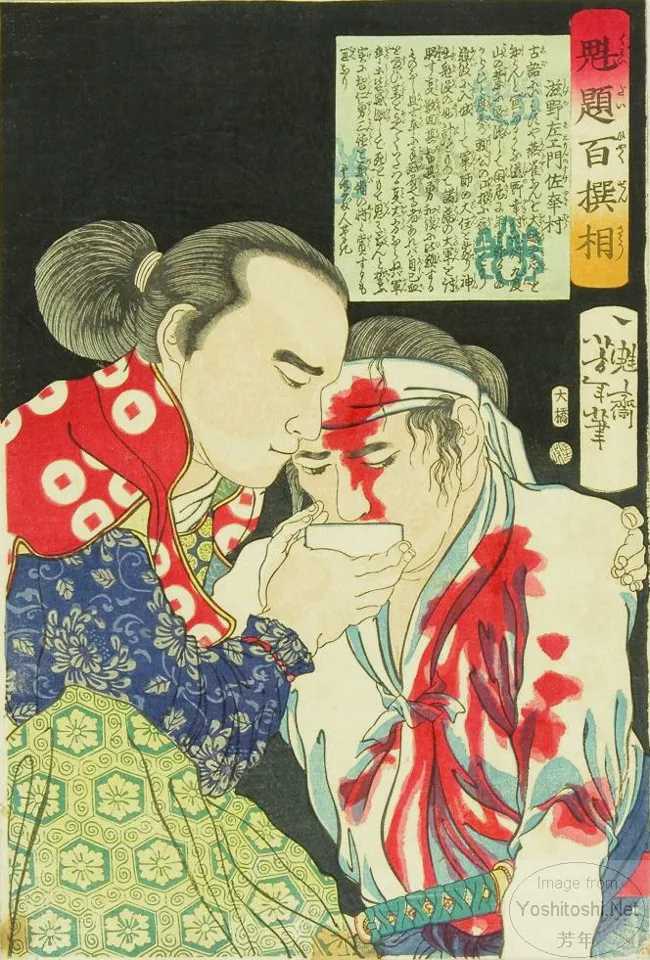 滋野 左エ門佐 幸/奉村Yukimura was a daimyo who served first Hideyoshi, and then Hideyori. He attempted to assasinate Tokugawa Ieyasu.VIEW PRINT ↗33Shigeno Saemonsuke Yukimura giving water to a wounded soldier.12/1868
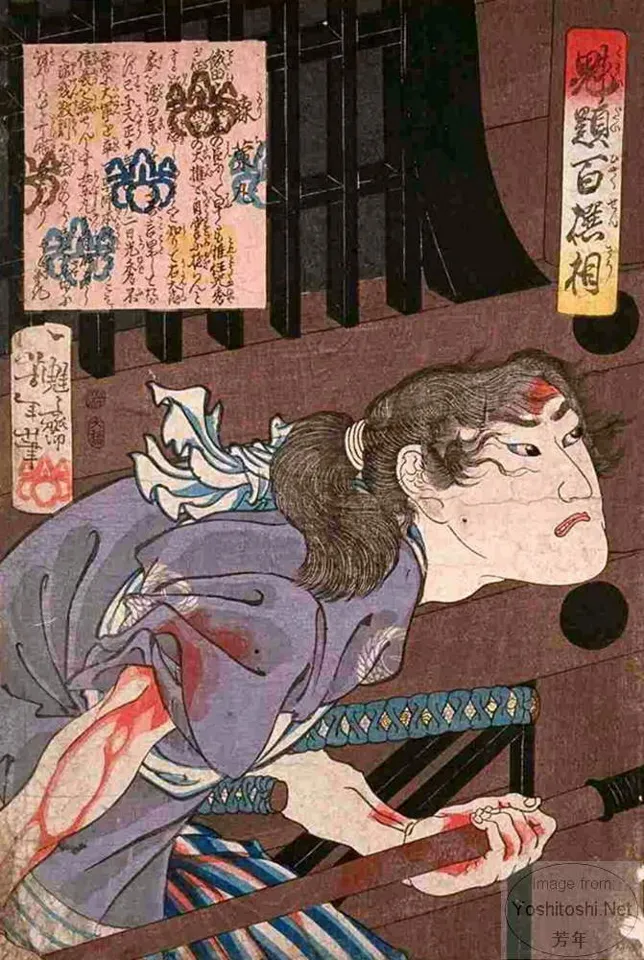 森 蘭丸Ranmaru was an attendant to Oda Nobunaga, and committed seppaku with him at Honnōji temple in 1582. The second kanji is not quite right; the correct character does not seem to be available in Unicode.VIEW PRINT ↗34Mori Ranmaru (Nagayasu) by a window with a spear12/1868
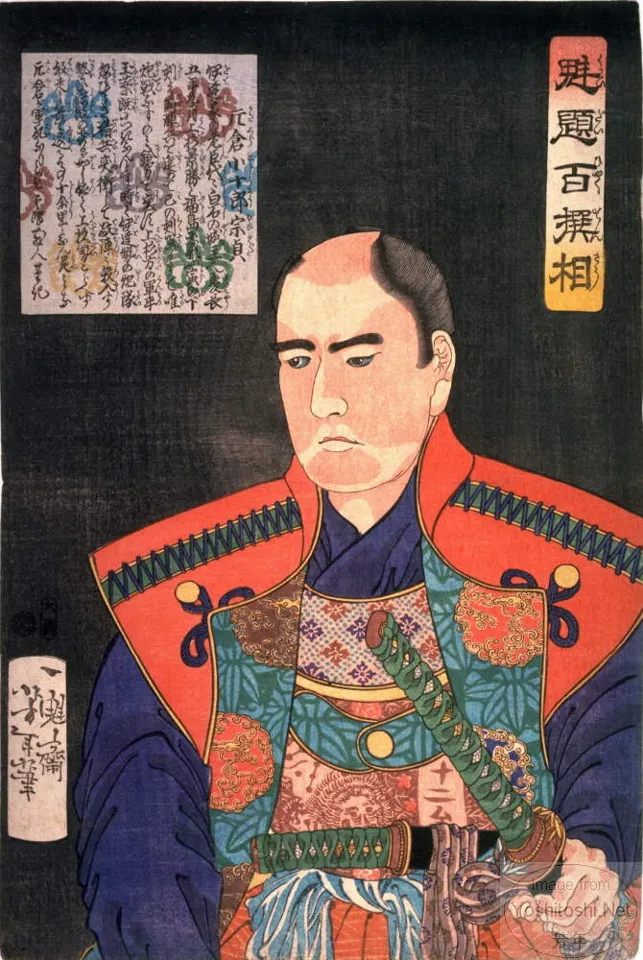 ?倉 小十郎 宗貞The first kanji is given as '?', not because it can't be seen clearly in the image, but because it seems to be an archaic form which is not available in Unicode. The first character of this name is now given as 片, but this one looks more like 元 or 斤.VIEW PRINT ↗35Katakura Kojūrō Munesada in battle dress facing left.12/1868
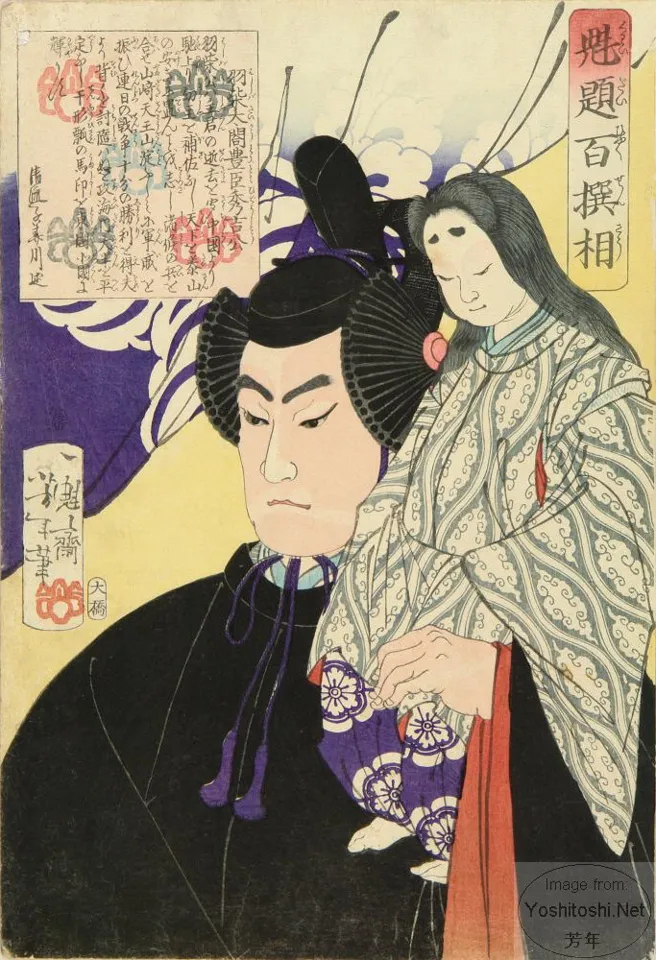 羽柴 太閤 豊臣 秀吉 公Hashiba Taikō Toyotomi Hideyoshi Kō holding a child on his shoulder.VIEW PRINT ↗36Hashiba Taikō Toyotomi Hideyoshi Kō holding a child on his shoulder.1868
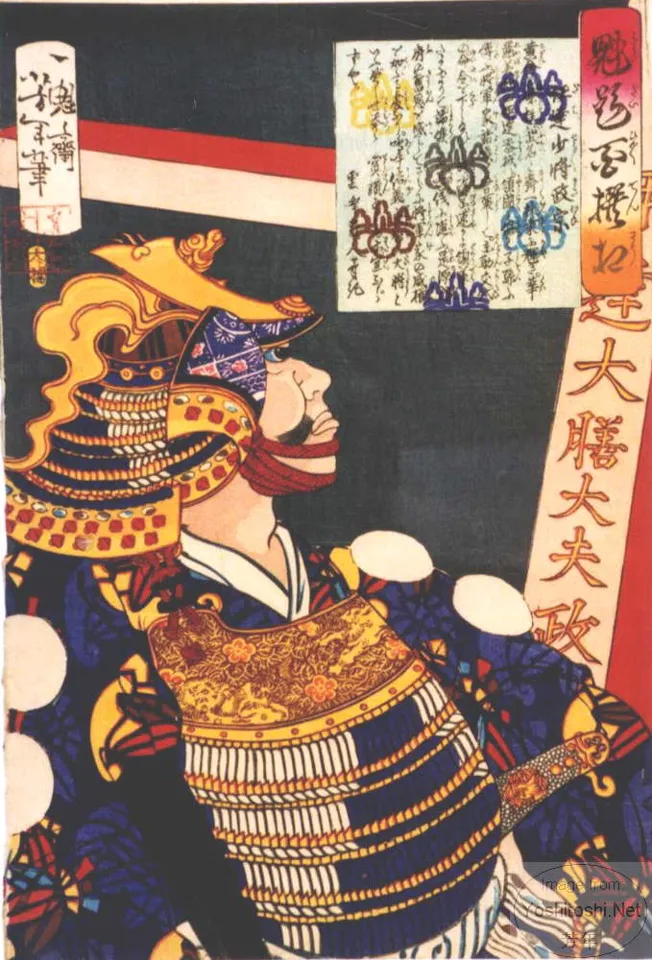 伊?達 少将 政宗The first kanji is marked '?' because it can't be seen clearly in the image; it probably is the correct character, though, as sources confirm this is the one used in this name.VIEW PRINT ↗37Date Shōshō Masamune in armor looking at banner.1868
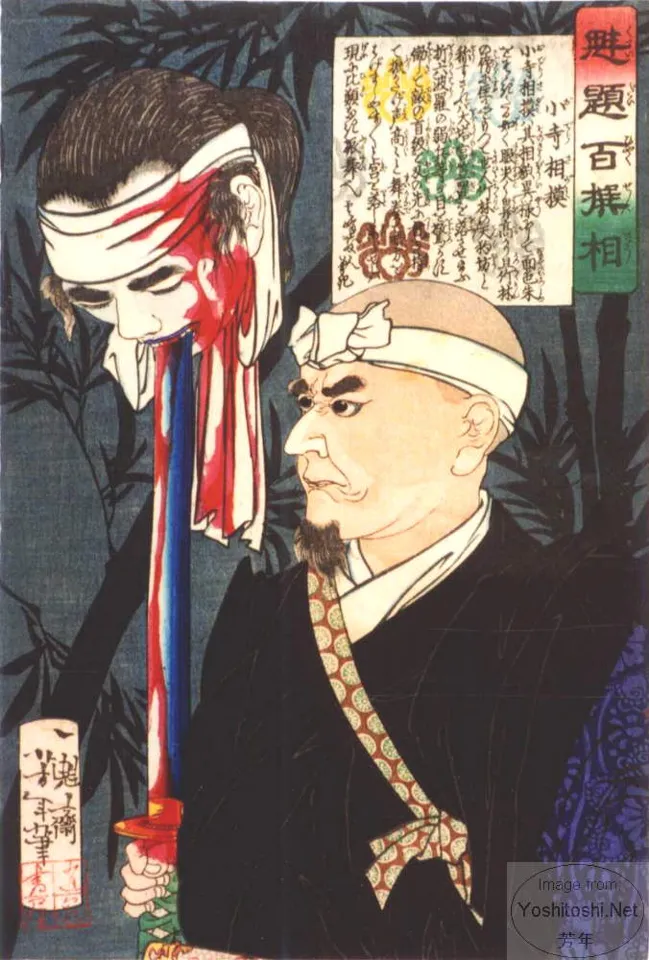 小寺 相模Odera Sagami holding sword with impaled head.VIEW PRINT ↗38Odera Sagami holding sword with impaled head.1868
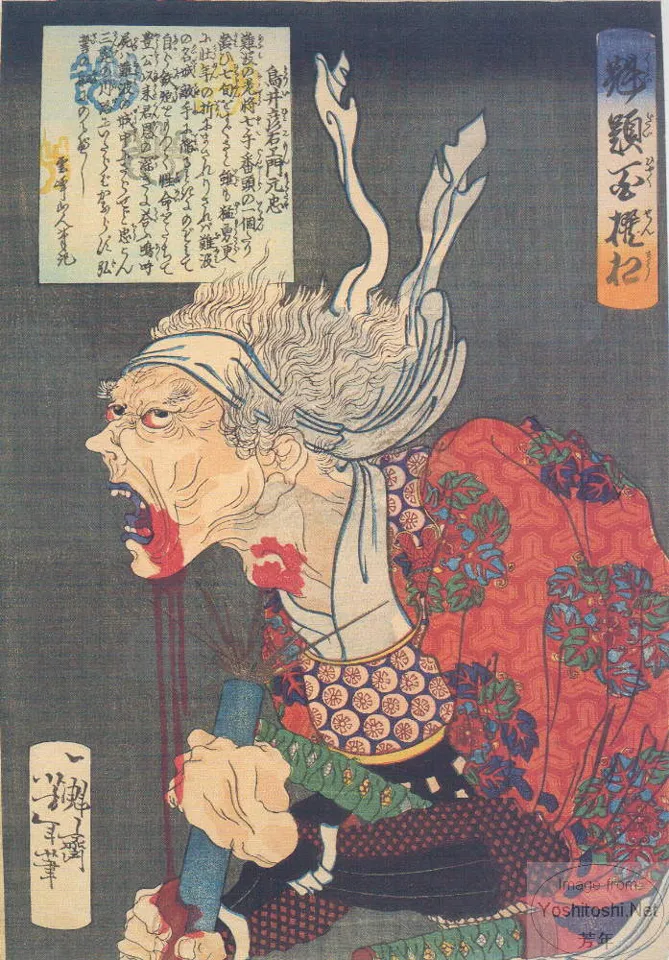 鳥井 彦右エ門 元忠Torii Hikoemon Mototada shooting himself with rifle.VIEW PRINT ↗39Torii Hikoemon Mototada shooting himself with rifle.1868
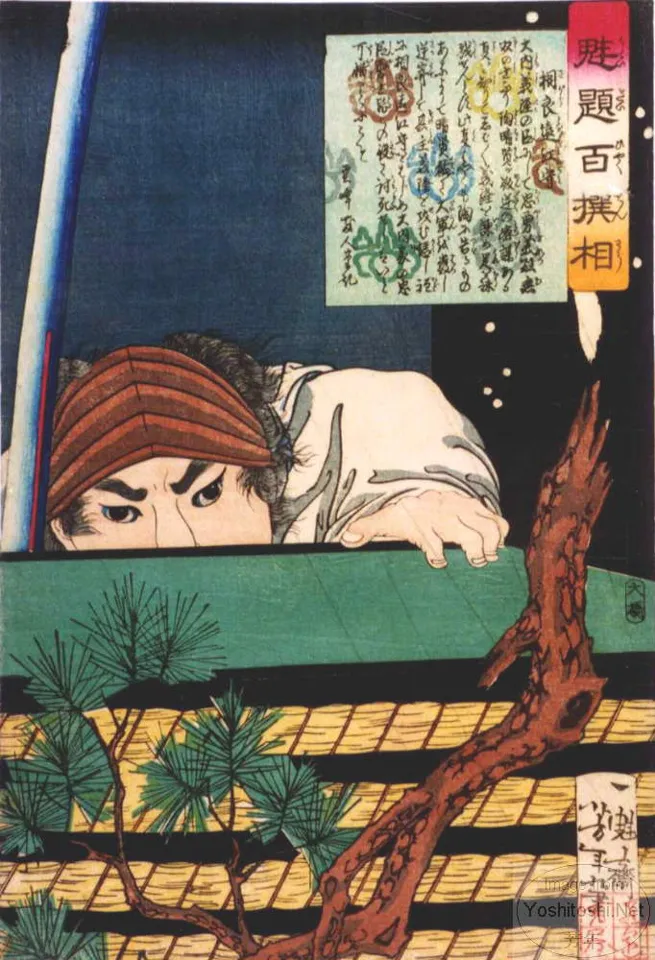 相良 遠江 守Sagara Tōtomi no Kami peering over pile of mats.VIEW PRINT ↗40Sagara Tōtomi no Kami peering over pile of mats.1868
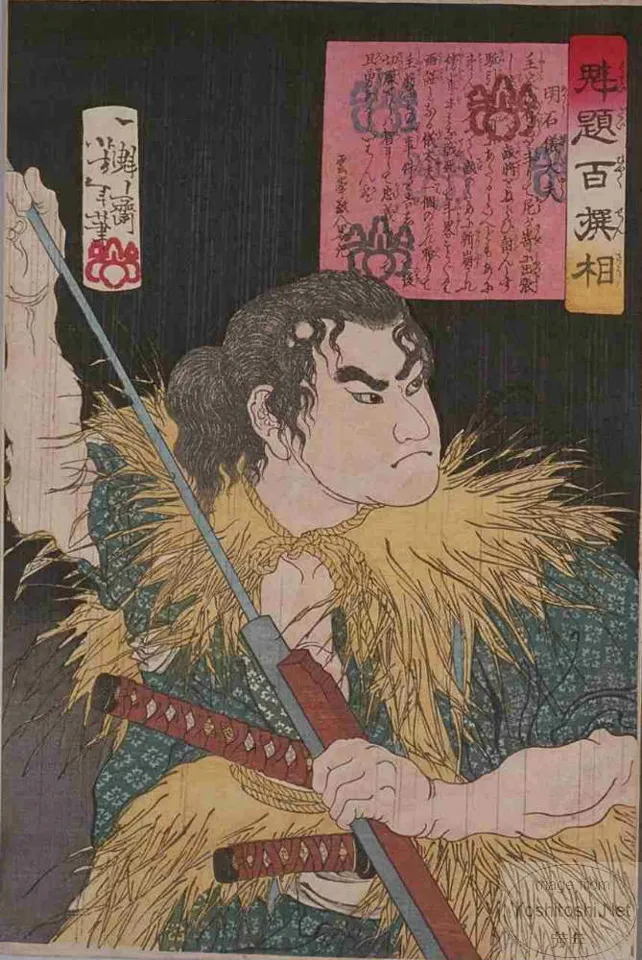 明石 儀太夫Akashi Gidayu loading rifle in rain.VIEW PRINT ↗41Akashi Gidayu loading rifle in rain.1868
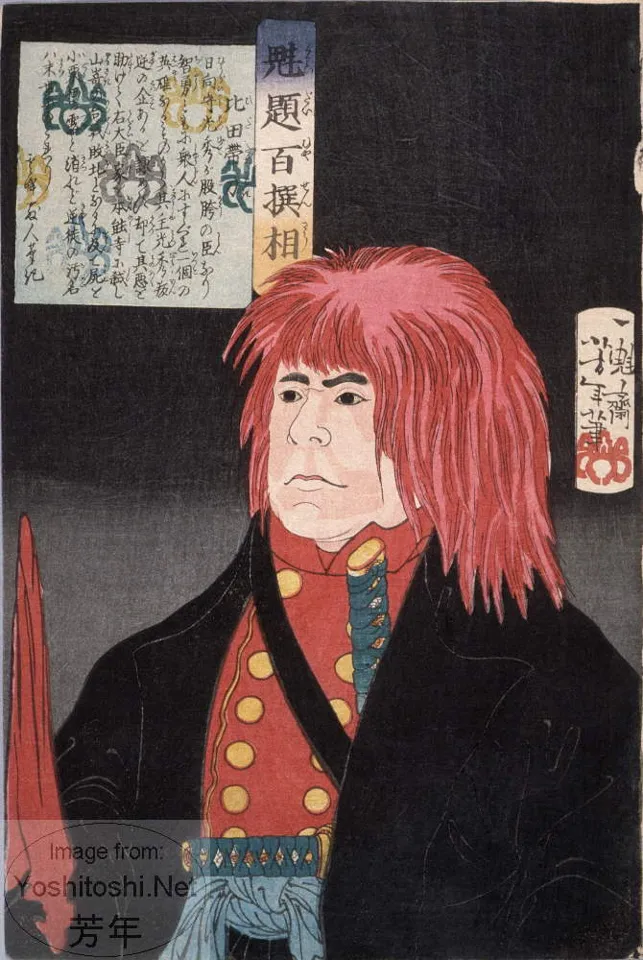 比田 帶刀Hida no Tatewaki waring a red wig.VIEW PRINT ↗42Hida no Tatewaki waring a red wig.1868
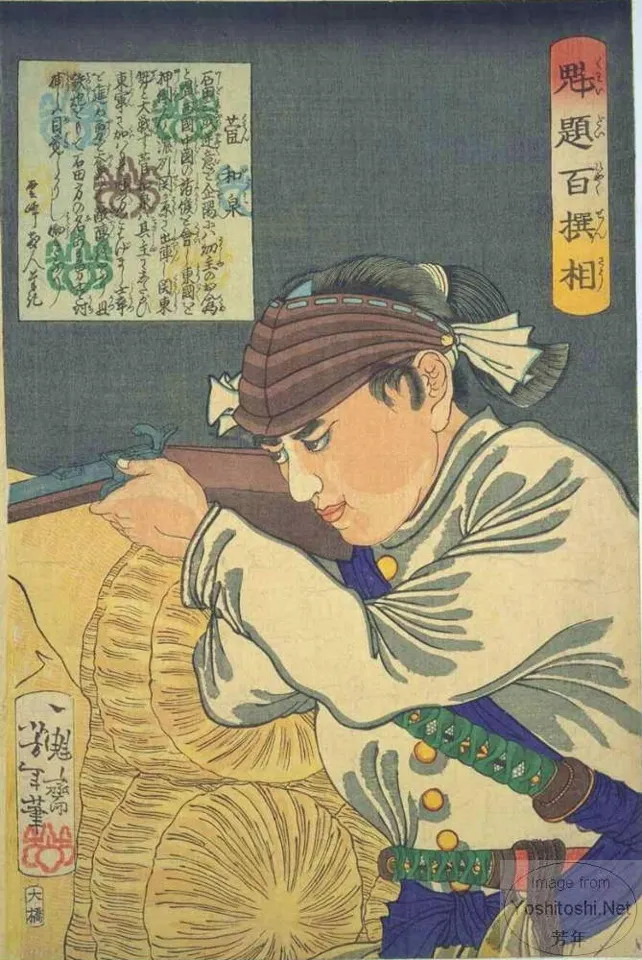 宦 和泉The first kanji is not quite right; the correct character does not seem to be available in Unicode.VIEW PRINT ↗43Kan Izumi aiming rifle from behind rice bales.1868
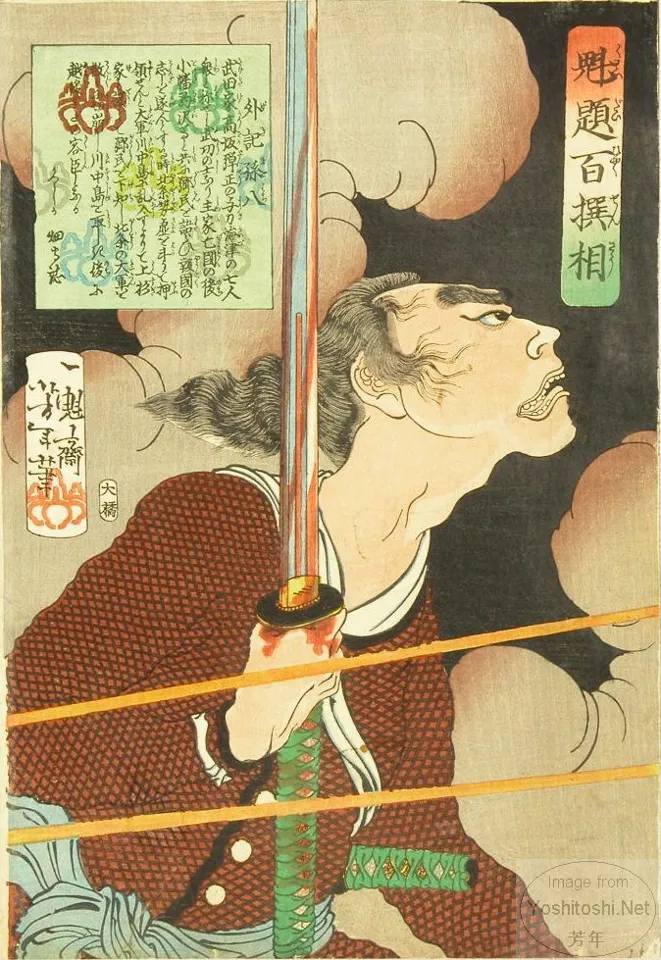 外記 孫八Geki Magohachi in smoke and rifle fire.VIEW PRINT ↗44Geki Magohachi in smoke and rifle fire.1868
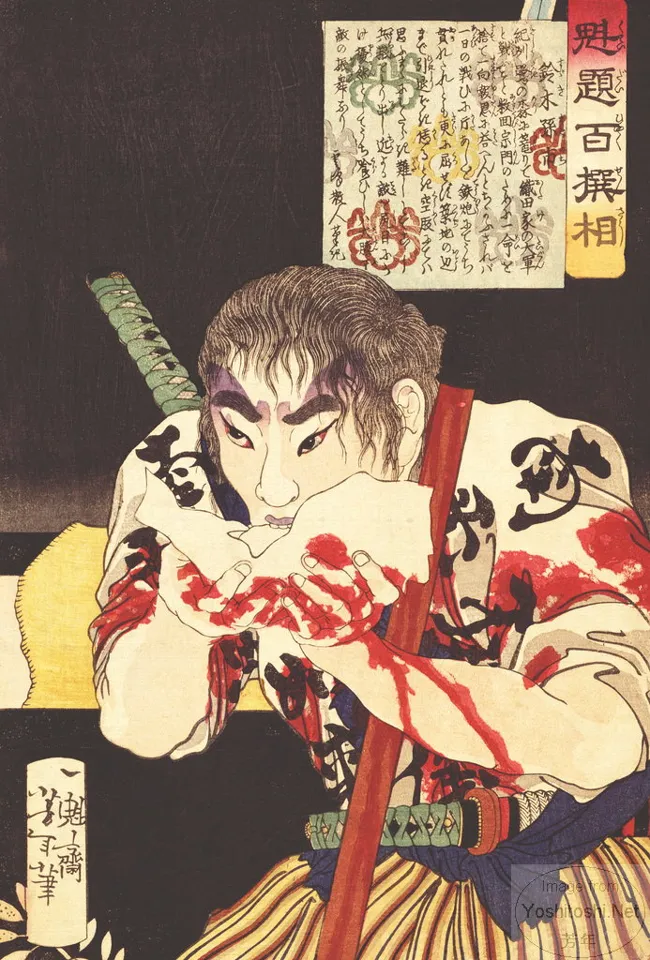 鈴木 孫市Suzuki Magoichi leaning on a spear and eating a riceball.VIEW PRINT ↗45Suzuki Magoichi leaning on a spear and eating a riceball.1868
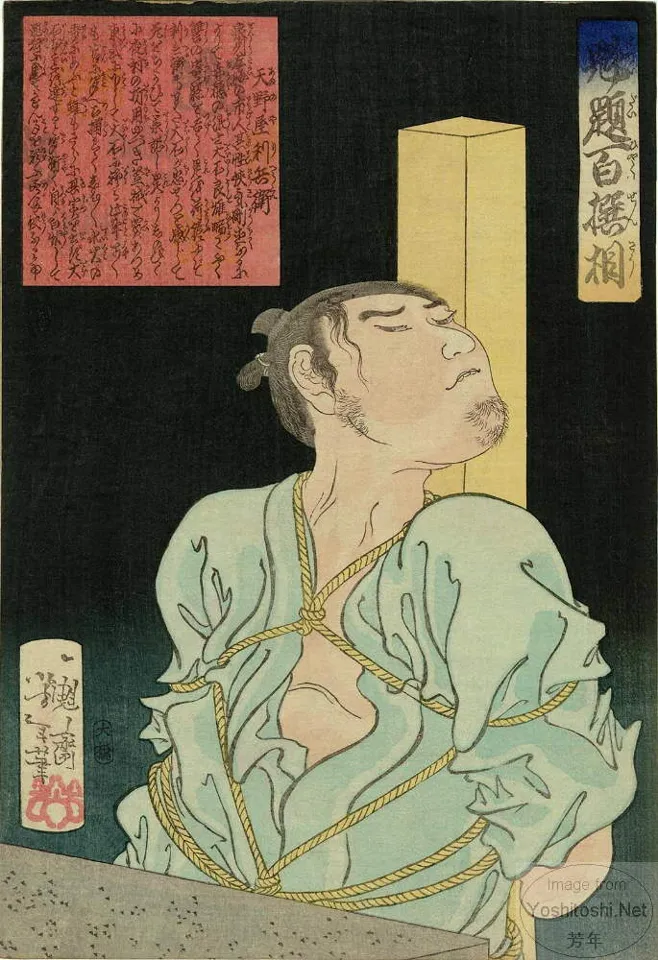 天野屋 利兵衛Amanoya Rihei bound to a post.VIEW PRINT ↗46Amanoya Rihei bound to a post.1868
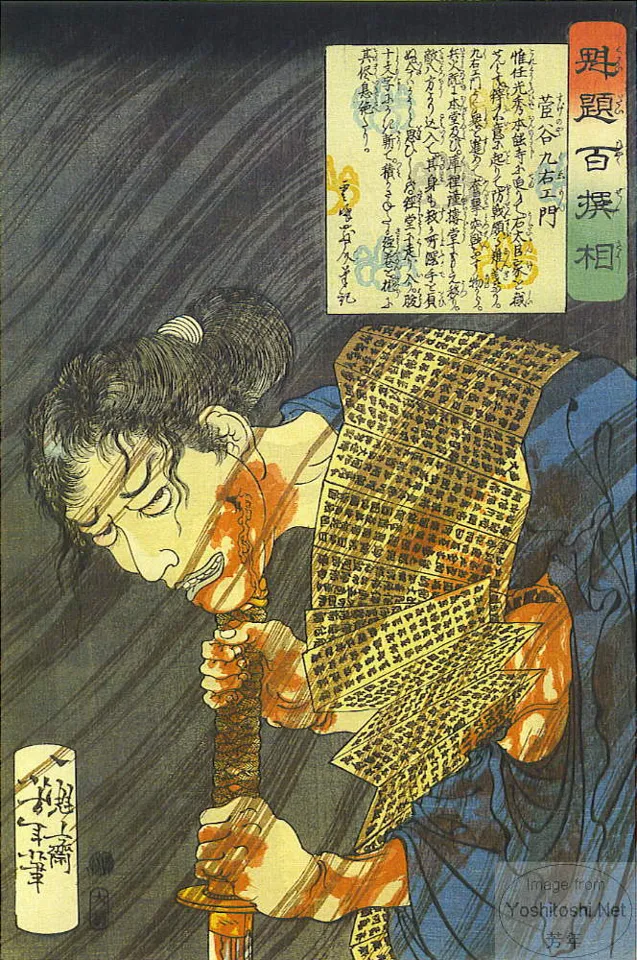 菅谷 九右エ門The first kanji is not quite right; the correct character does not seem to be available in Unicode.VIEW PRINT ↗47Sugenoya Kuemon supporting himself in wind on sword.1868
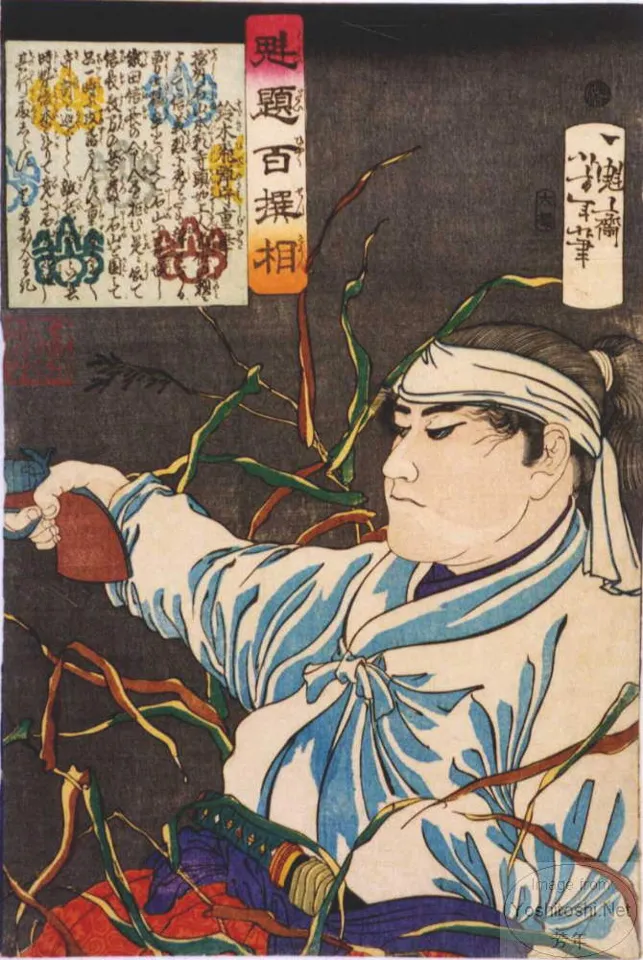 鈴木 飛弾 守 重幸Here he lies in ambush, attempting to shoot Oda Nobubaga.VIEW PRINT ↗48Suzuki Hida-no-Kami Shigeyuki aiming pistol.1868
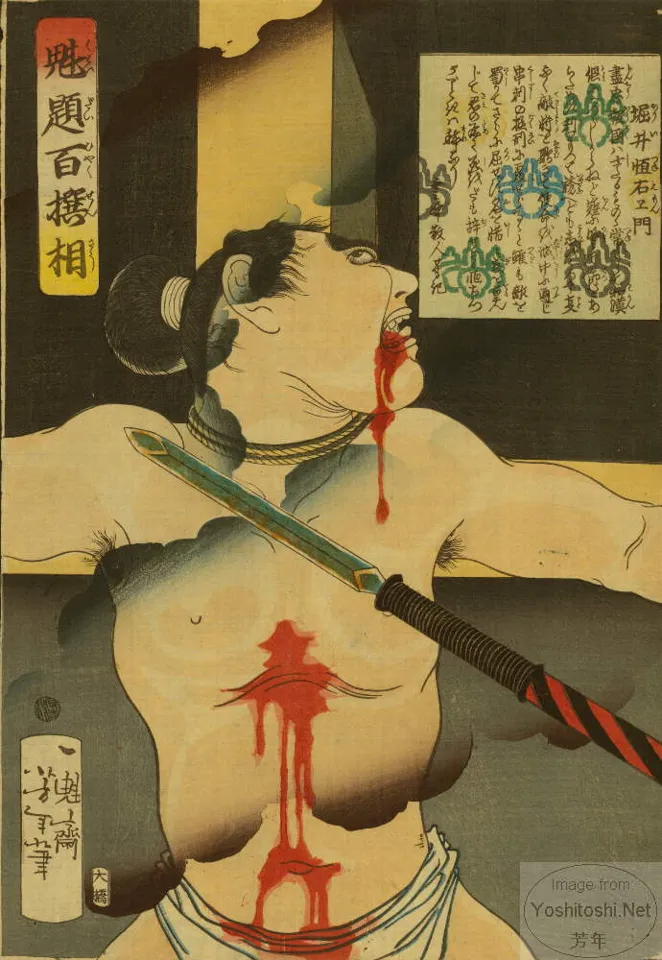 堀井 恒右エ門He was a retainer of Okudaira Nobumatsu, who died in 1575.VIEW PRINT ↗49Horii Tsune'emon crucified.12/1868
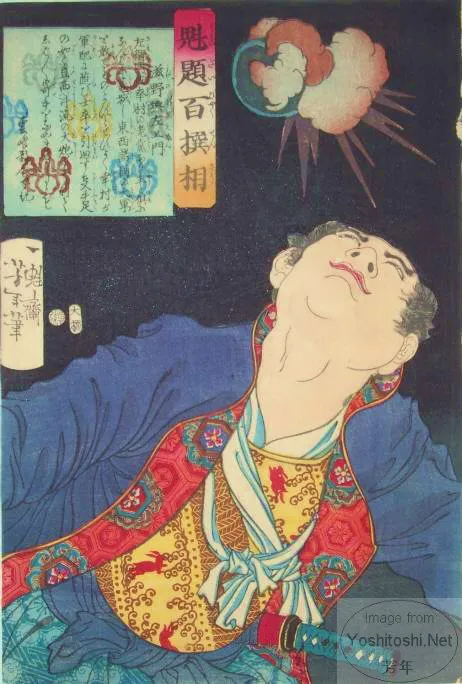 滋野 與左エ門Shigeno Yozaemon and an exploding shell.VIEW PRINT ↗50Shigeno Yozaemon and an exploding shell.1/1869
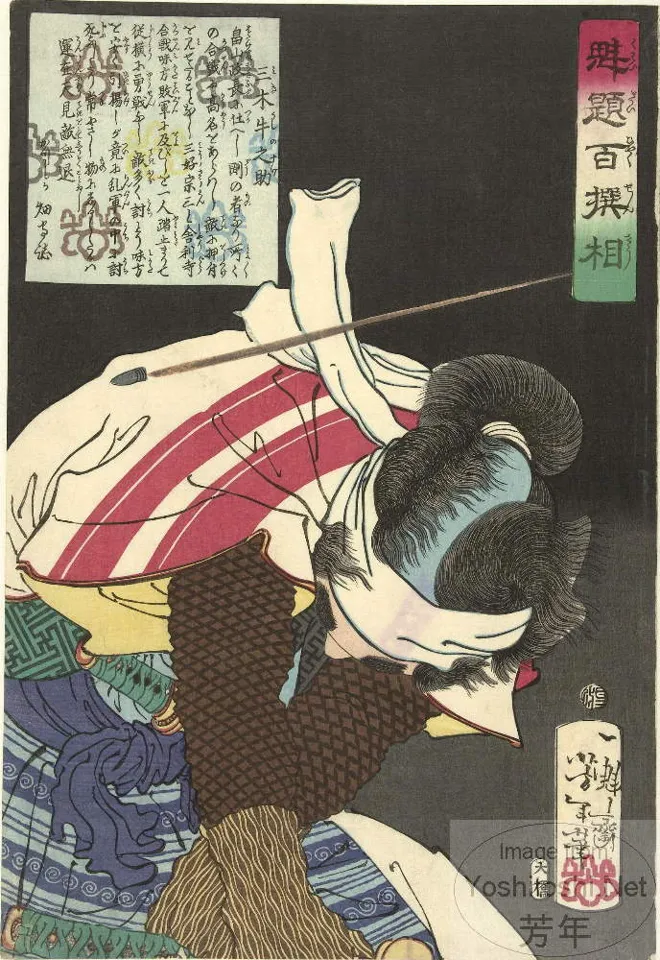 三木 牛之助Miki Ushinosuke ducking a bullet.VIEW PRINT ↗51Miki Ushinosuke ducking a bullet.3/1869
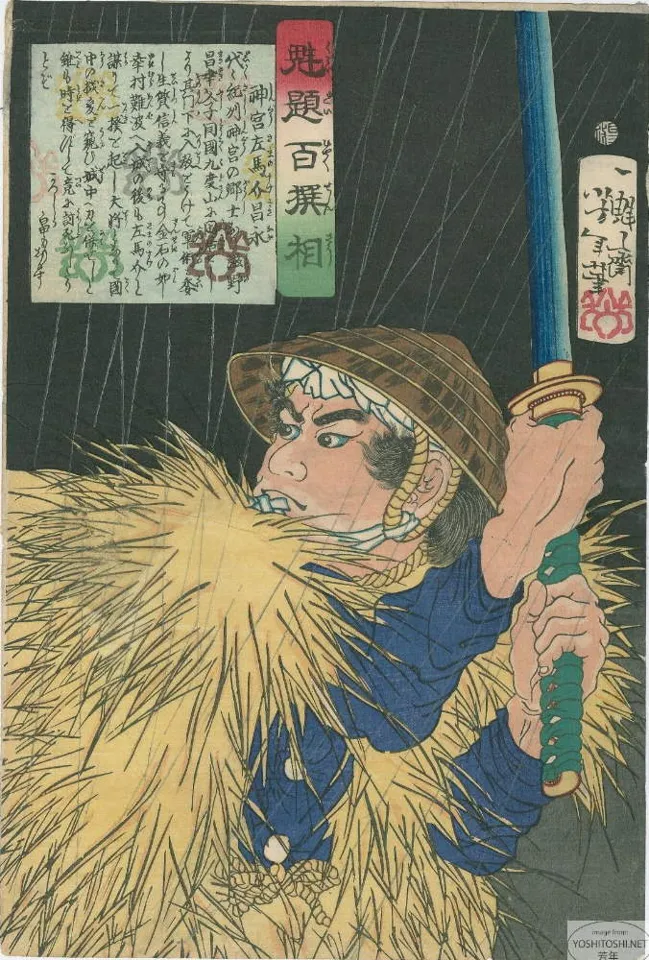 神官 左馬介 昌永Shingu Samanosuke Masanaga raising sword in rain.VIEW PRINT ↗52Shingu Samanosuke Masanaga raising sword in rain.3/1869
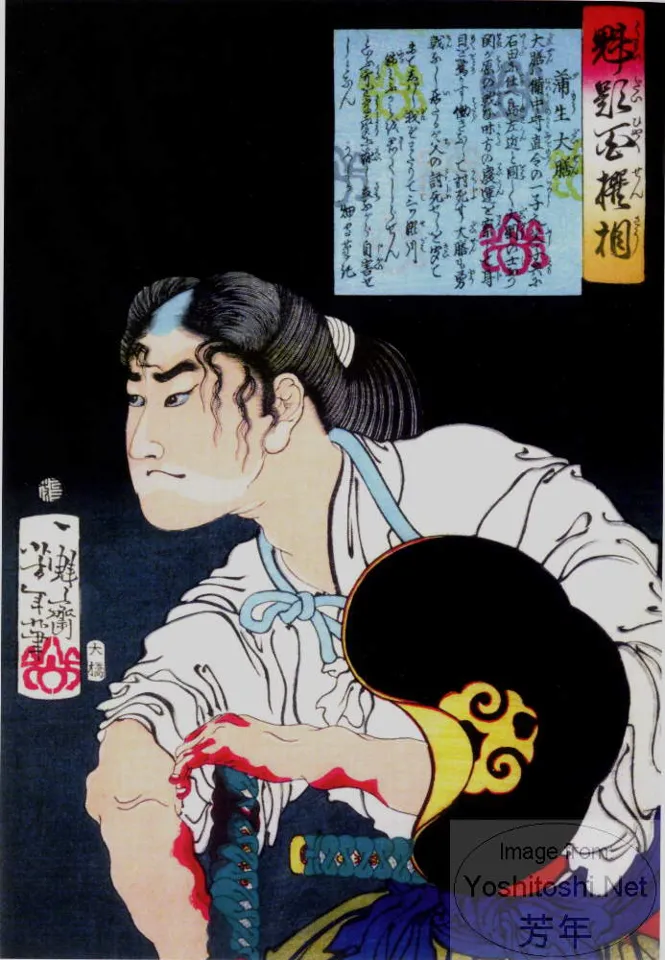 蒲生 大膳The first kanji looks slightly different from the one given here, but this appears to simply be calligraphic style.VIEW PRINT ↗53Gamō Daizen with hat tied around neck3/1869
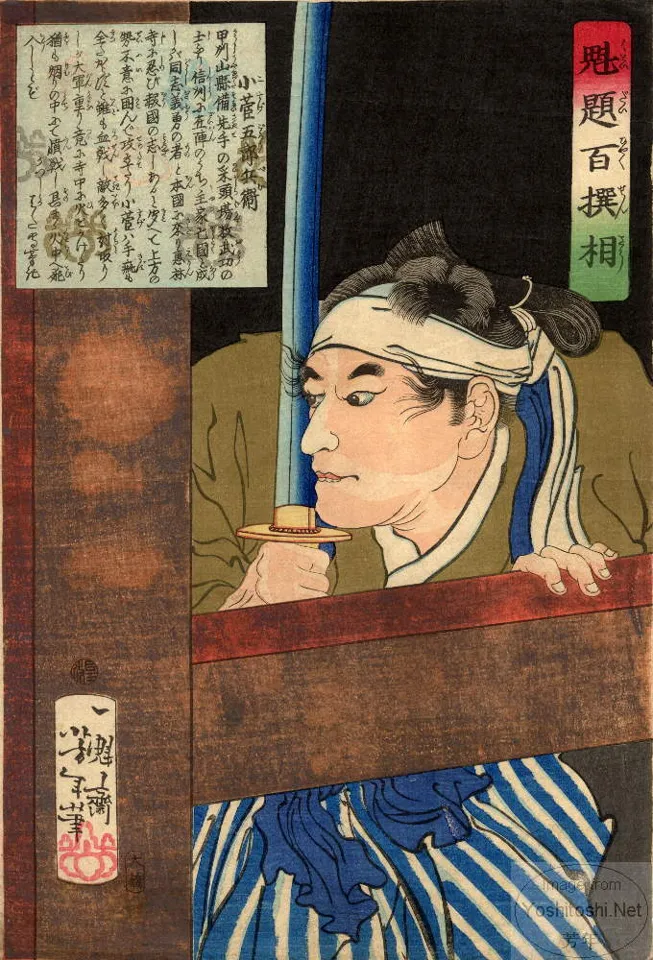 小菅 五郎兵衞The second kanji is not quite right; the correct character does not seem to be available in Unicode.VIEW PRINT ↗54Kosuge Gorobei peering around post3/1869
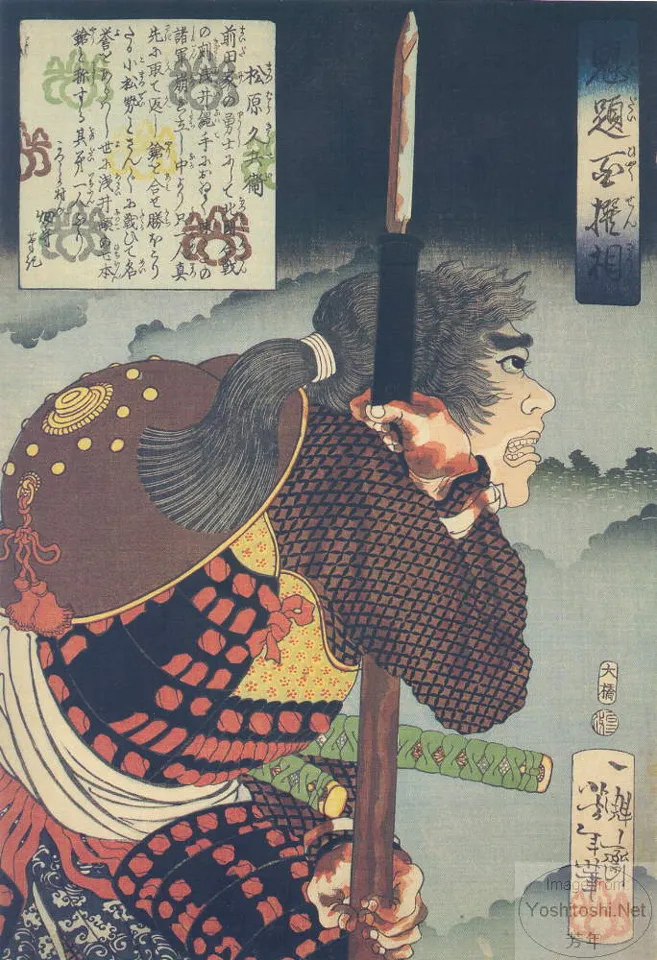 松原 久兵衛Matsubara Kyubei in armor leaning on spearVIEW PRINT ↗55Matsubara Kyubei in armor leaning on spear3/1869
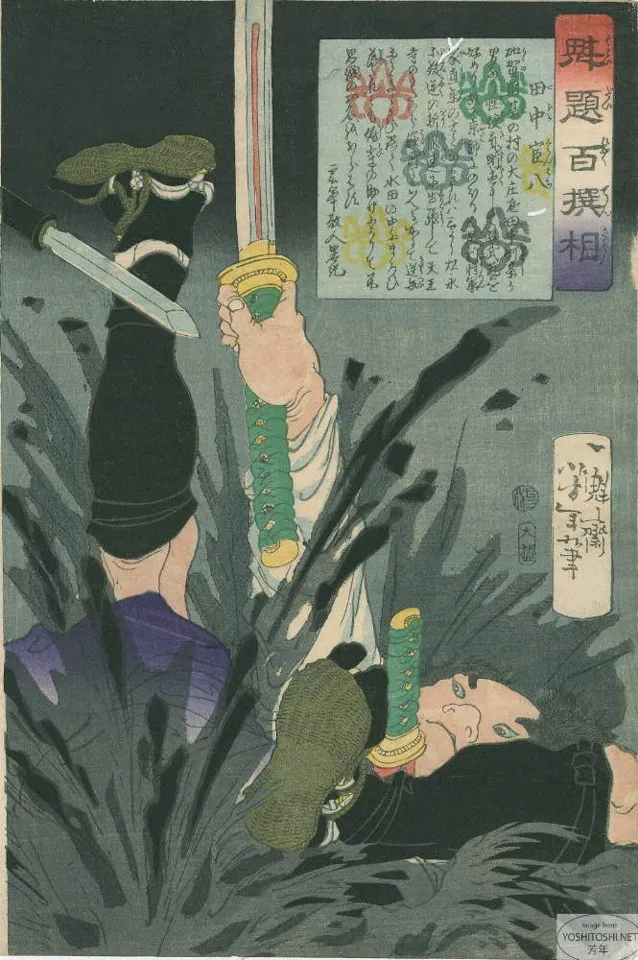 田中 宦八Tanaka Kanhachi falling in mudVIEW PRINT ↗56Tanaka Kanhachi falling in mud3/1869
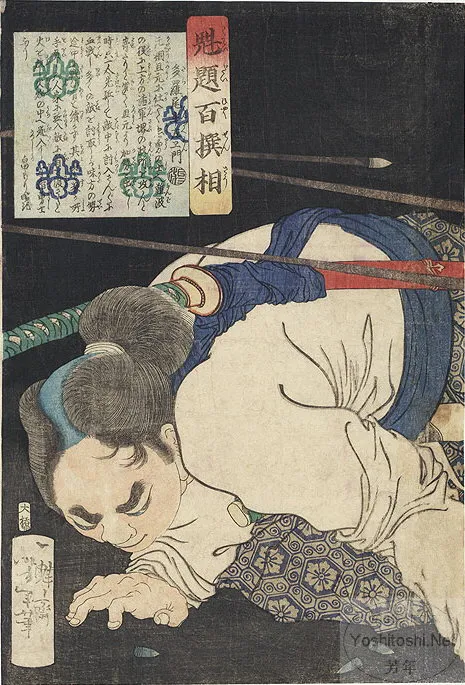 多羅尾 半左エ?門Tarao Hanzaemon creeping below rifle fireVIEW PRINT ↗57Tarao Hanzaemon creeping below rifle fire3/1869
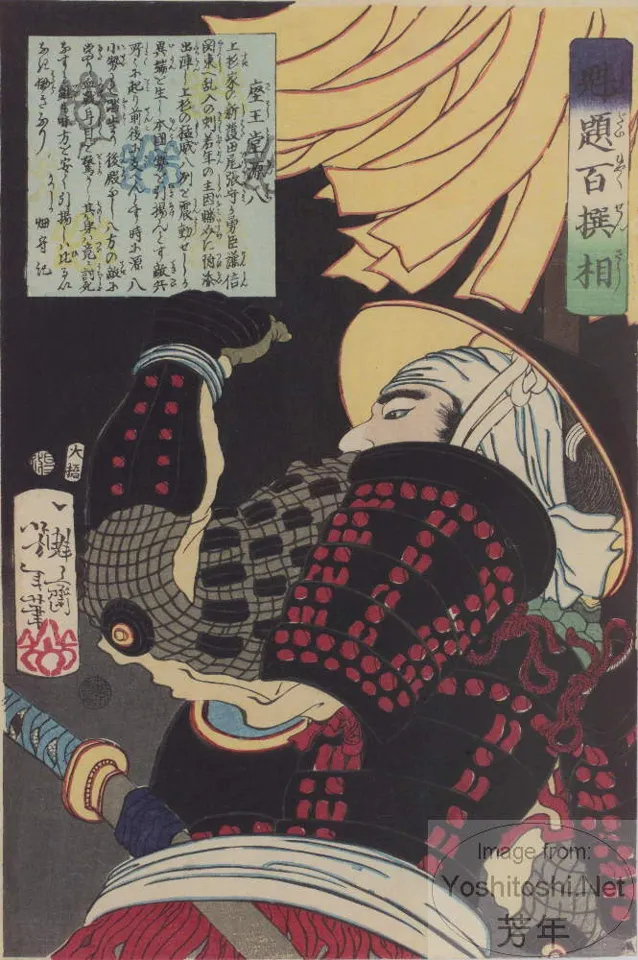 座王堂 源八Saōdō Gempachi in armor holding a standardVIEW PRINT ↗58Saōdō Gempachi in armor holding a standard3/1869
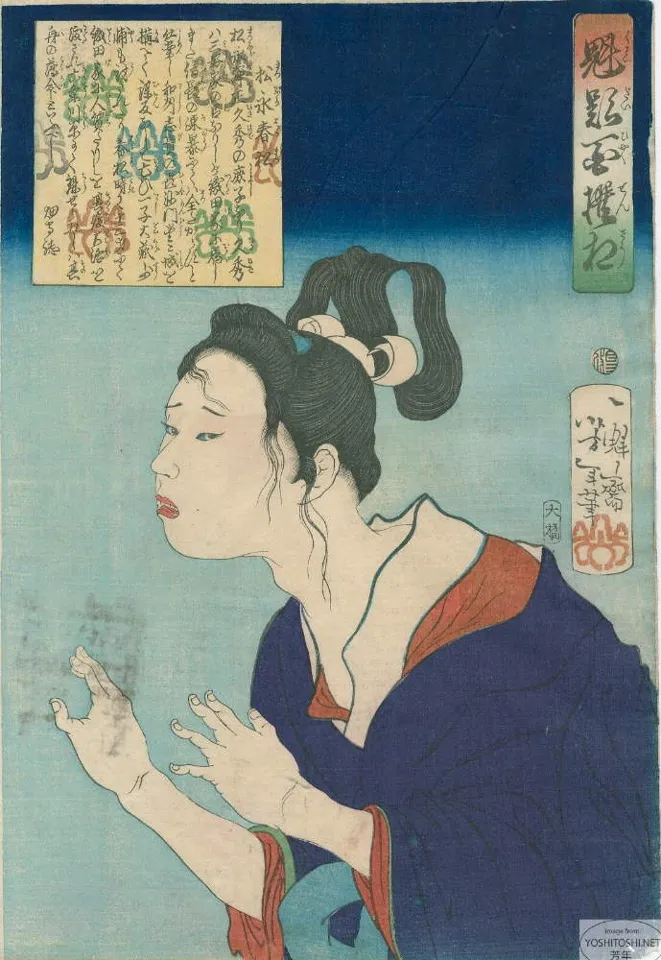 松永 春松Matsunaga Harumatsu raising handsVIEW PRINT ↗59Matsunaga Harumatsu raising hands3/1869
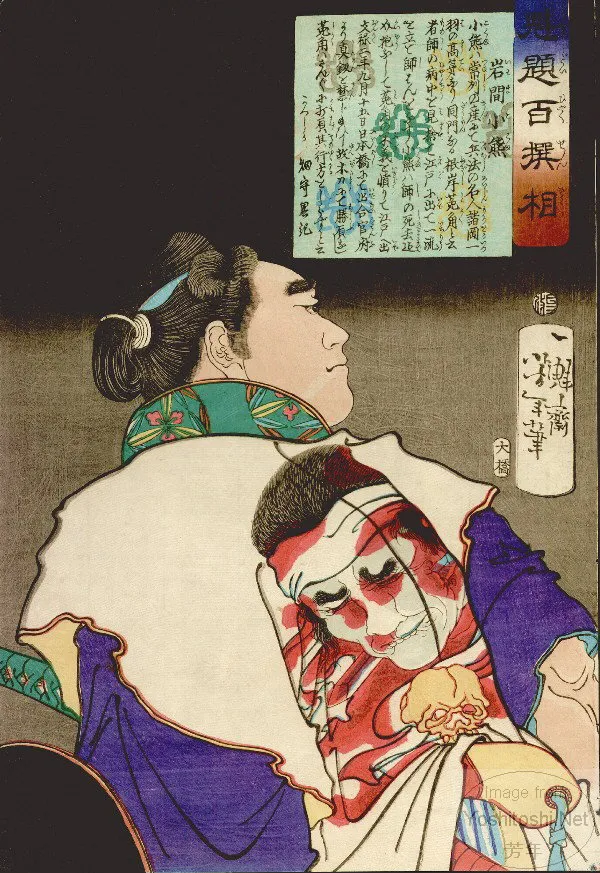 岩間 小熊Iwama Kokuma with painting of bloody head on jacket.VIEW PRINT ↗60Iwama Kokuma with painting of bloody head on jacket.3/1869
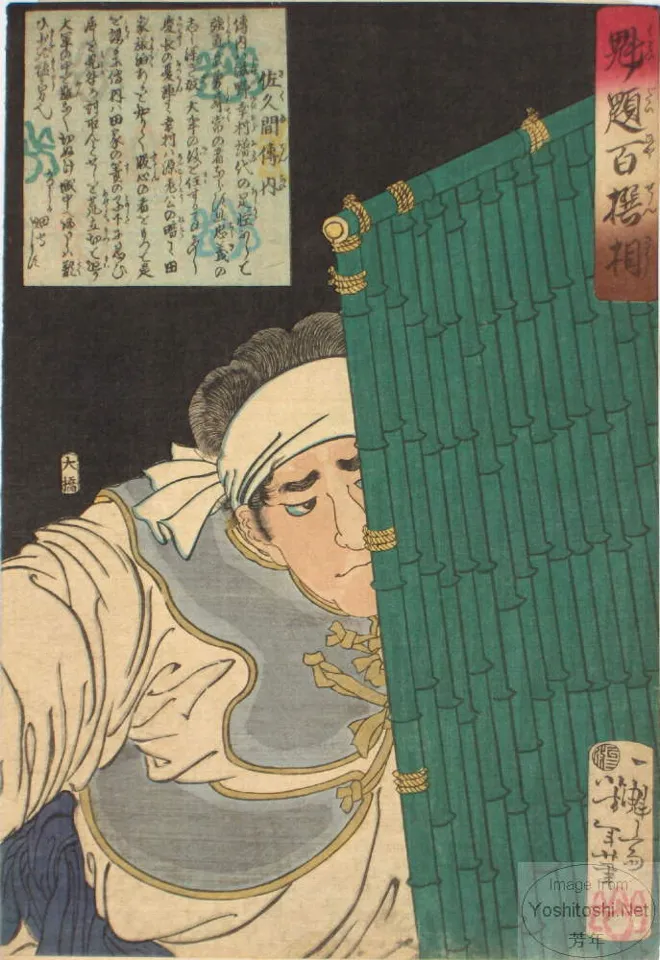 佐久間 傳内He is shown using a bamboo fence as a shield.VIEW PRINT ↗61Sakuma Dennai3/1869
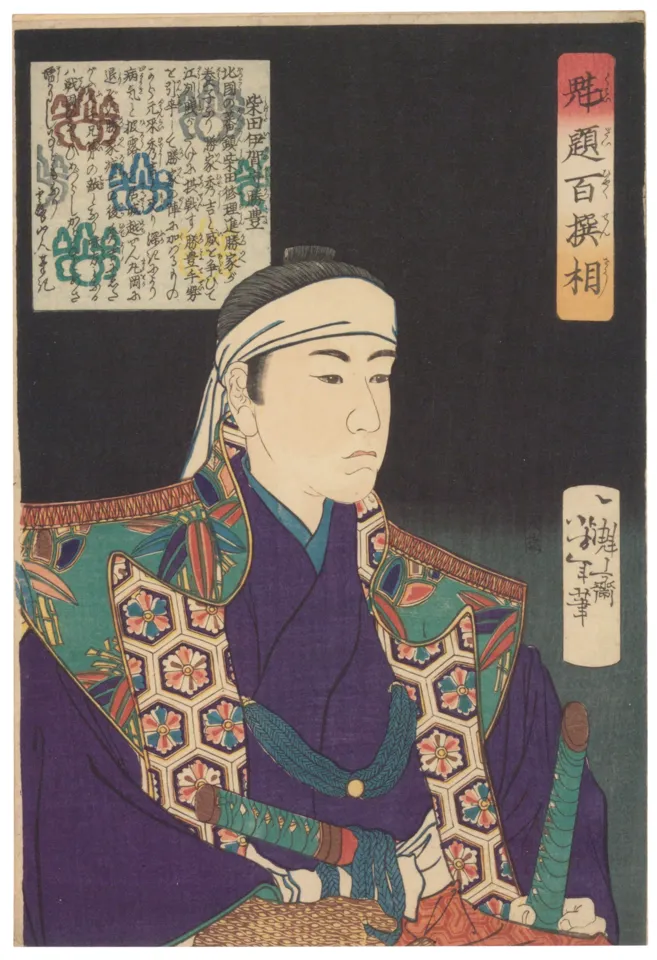 柴田 伊賀守 勝豊Shibata Katsutoyo defended Nagahama castle, and surrendered to Hideyoshi in 1583.VIEW PRINT ↗62Shibata Iga no Kami KatsutoyoDate not recorded
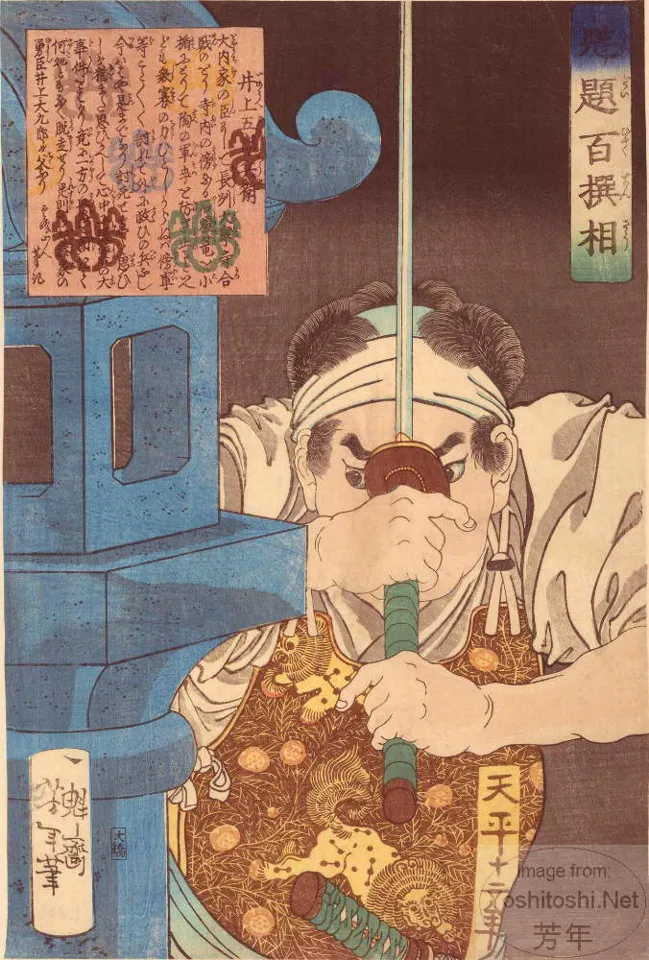 井上 五郎兵衛He is shown standing next to an ishi-dōrō (Japanese stone lantern).VIEW PRINT ↗63Inoue GorōbeiDate not recorded
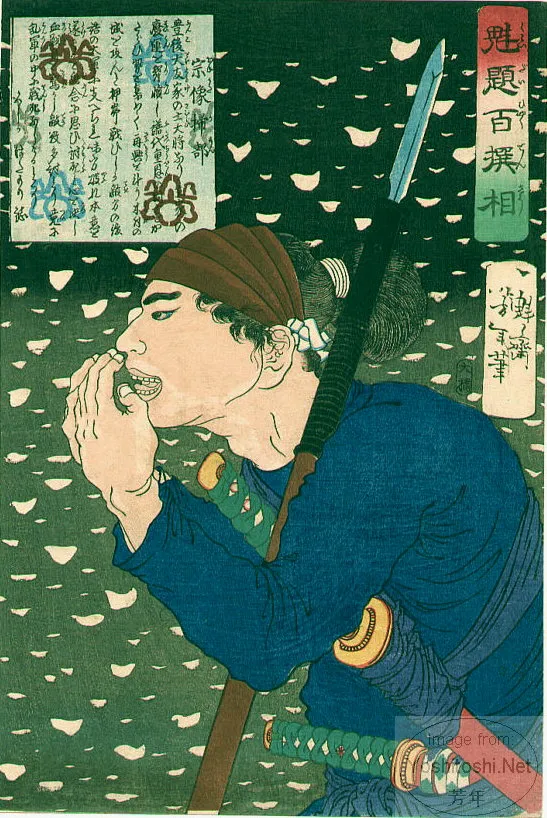 宗像 掃部?Munakata Kamon Shigetsugu was a vassal of the Nakagawa lords of Oka castle; he supported Ōtomo Yoshimune during the Sekigahara campaign.VIEW PRINT ↗64Munakata KamonDate not recorded
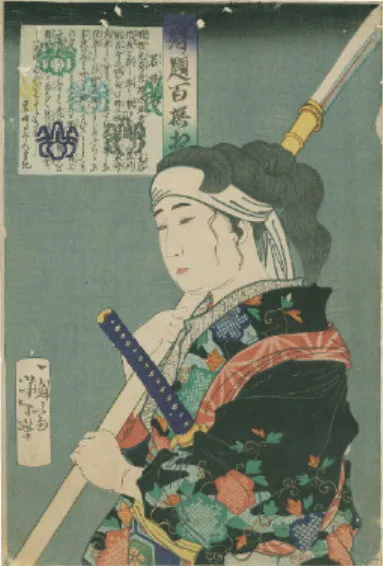 若狭局Court lady Wakasa (usually known as Wakasa no Tsubone) was the daughter of Hiki Yoshikazu, a famous warrior-noble of the Kamakura period, and wife of Minamoto no Yoriie, one of the last Shōguns of the Seiwa Genji line. They were involved in a famous episode of feudal Japan, when her 6-year old son with Yoriee, Minamoto no Ichiman, was killed during a power struggle over the Shogunate. Reportedly, she soon afterwards drowned herself in despair, in a nearby well.VIEW PRINT ↗65Wakasa tsuboneDate not recorded
Descriptions and title uncertainties are preserved from the original catalogue. Images are presented as reduced display copies.
This series dates from early in Yoshitoshi’s career and constitutes some of his most important work from this period. One of his first major series, it comprises 65 published prints of a planned 100; sketches of several unpublished designs also exist.
Renowned for graphic depictions of warriors in battle, the series reflects the upheaval of the Meiji Restoration. Yoshitoshi witnessed bloody battles firsthand, an influence visible throughout these images.
The conventional English title is not a literal translation. The unusual compound Kaidai suggests those who charge ahead, a meaning not fully captured by “warrior.”
Prints are ordered by Keyes catalogue numbers. Romanized names were checked against Satomi Aoki’s Tsukioka Yoshitoshi’s Samurai Road. Question marks and alternative characters indicate uncertainties in the source catalogue.
The original catalogue cautions that some Japanese characters could not be verified from the available images. Its transcription notes are retained on the corresponding print records. Some display and larger source images represent different impressions.
These works contain historical scenes of violence.
SCHOLARSHIP & ACKNOWLEDGEMENTS
Roger S. Keyes · 1982
A Study of the Life and Color Woodblock Prints of Tsukioka Yoshitoshi 1839–1892. Series 223.Eric van den Ing & Robert Schaap · 1992
Japanese Prints by Yoshitoshi 1839–1892. Series 22; pages 13, 46–47, 108.Shinichi Segi · 1985
Kodansha International. Color plates 10–14; pages 35, 40–41, 103, 112.Shinbaku Books · 2014
Samurai Art by Yoshitoshi. A complete series survey with subjects and an overview of musha-e.With thanks to The Rijksmuseum, which supplied the source catalogue’s high-resolution image of print 63.