THE SERIES COLLECTION · KEYES 116
Modern Journey to the West
通俗西遊記
Tsūzoku saiyūki
Tsukioka Yoshitoshi · 1864–1865
THE SERIES COLLECTION
MODERN JOURNEY TO THE WEST通俗西遊記
Hover to view details. Select a print to open its image and description.
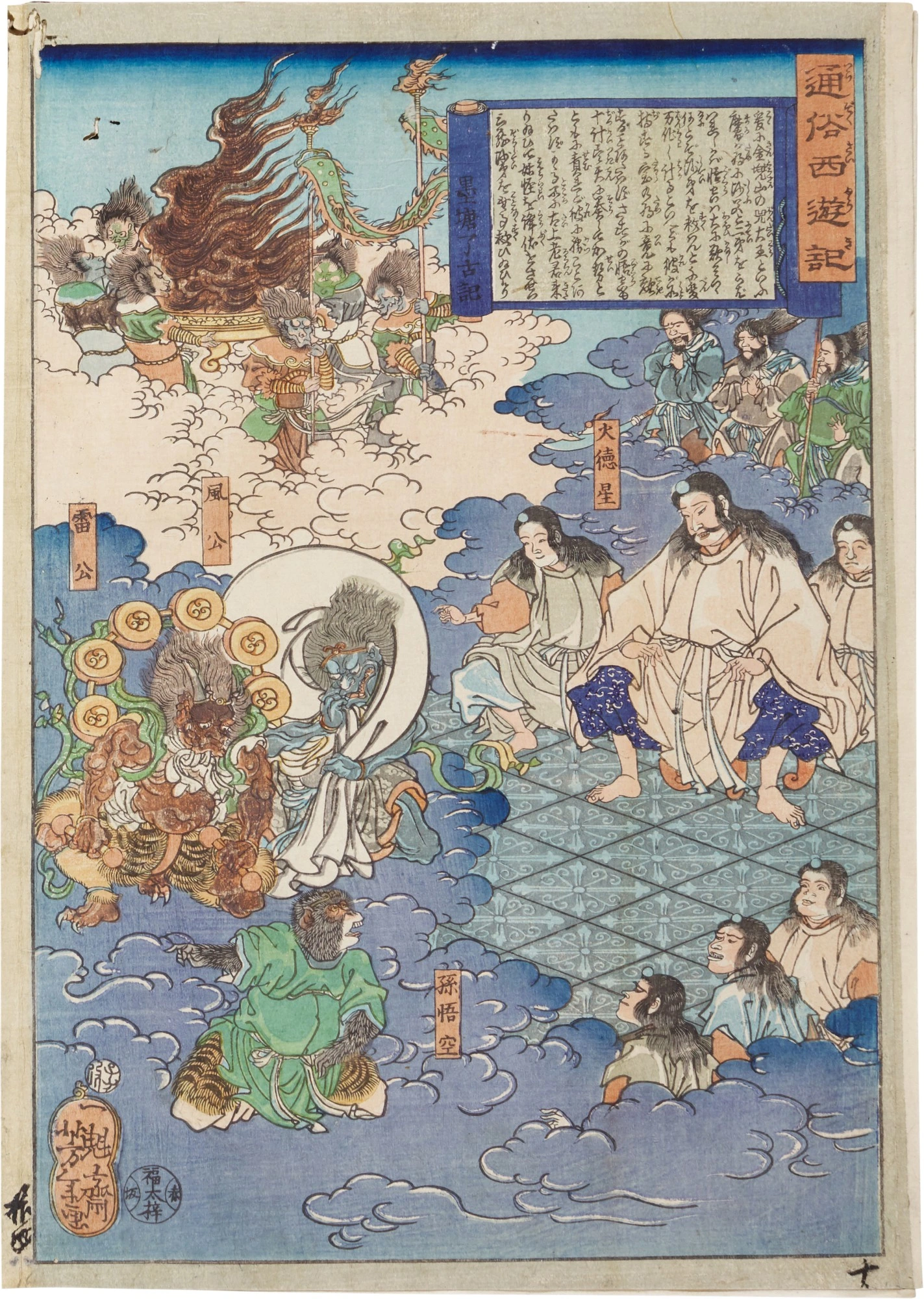
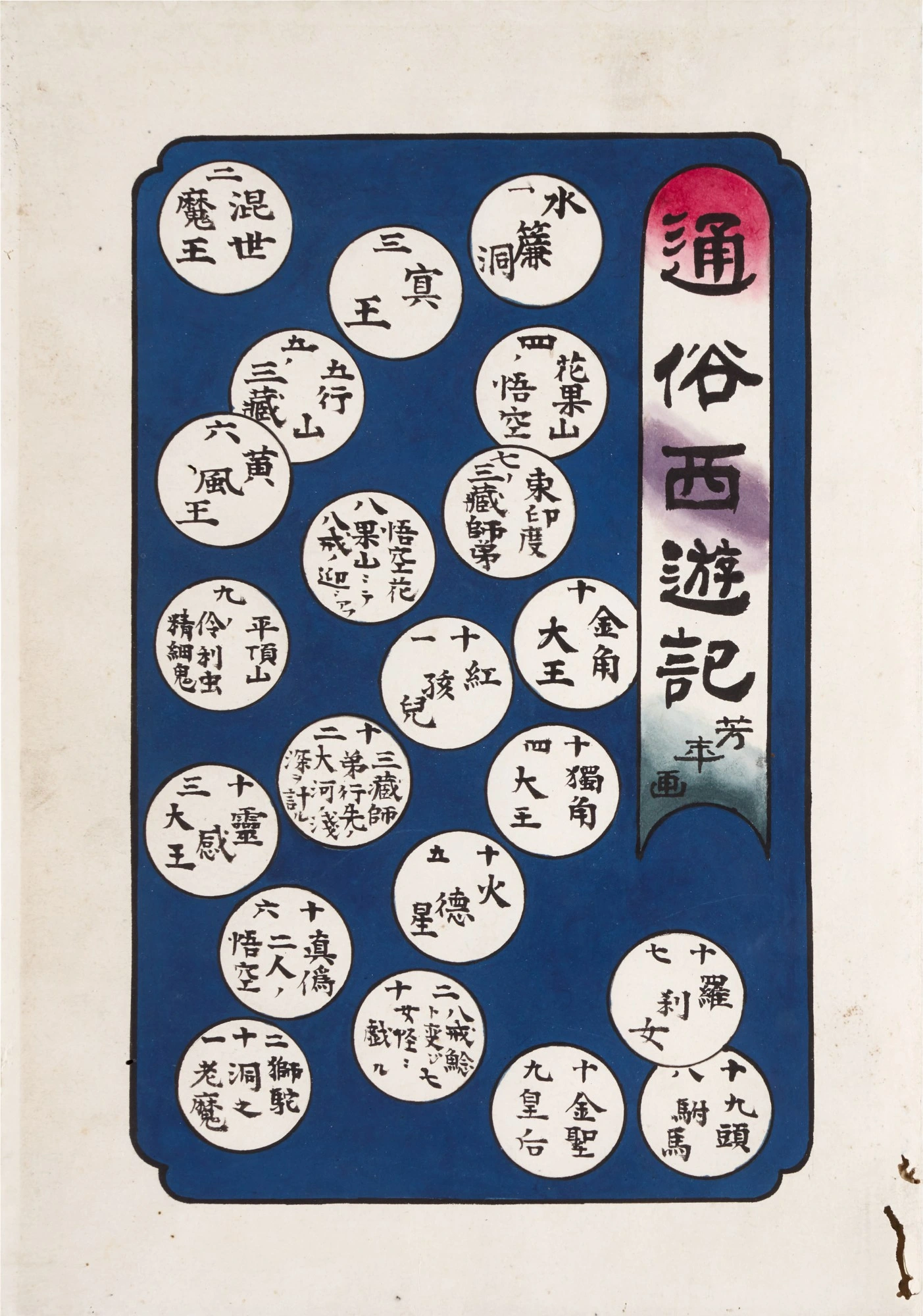 通俗西遊記The series title and a numbered list of its twenty-one narrative subjects.VIEW PRINT ↗Title and ContentsTitle and Contents Page雷公 / 風公 / 大徳星The identity of Daitokusei is not certain; he may be the persona Taibai Jinxing. The other two seem to be some sort of demi-gods of thunder (Fūkō) and wind (Raikō).VIEW PRINT ↗#1Son Gokū among the Celestial Deities1864/10
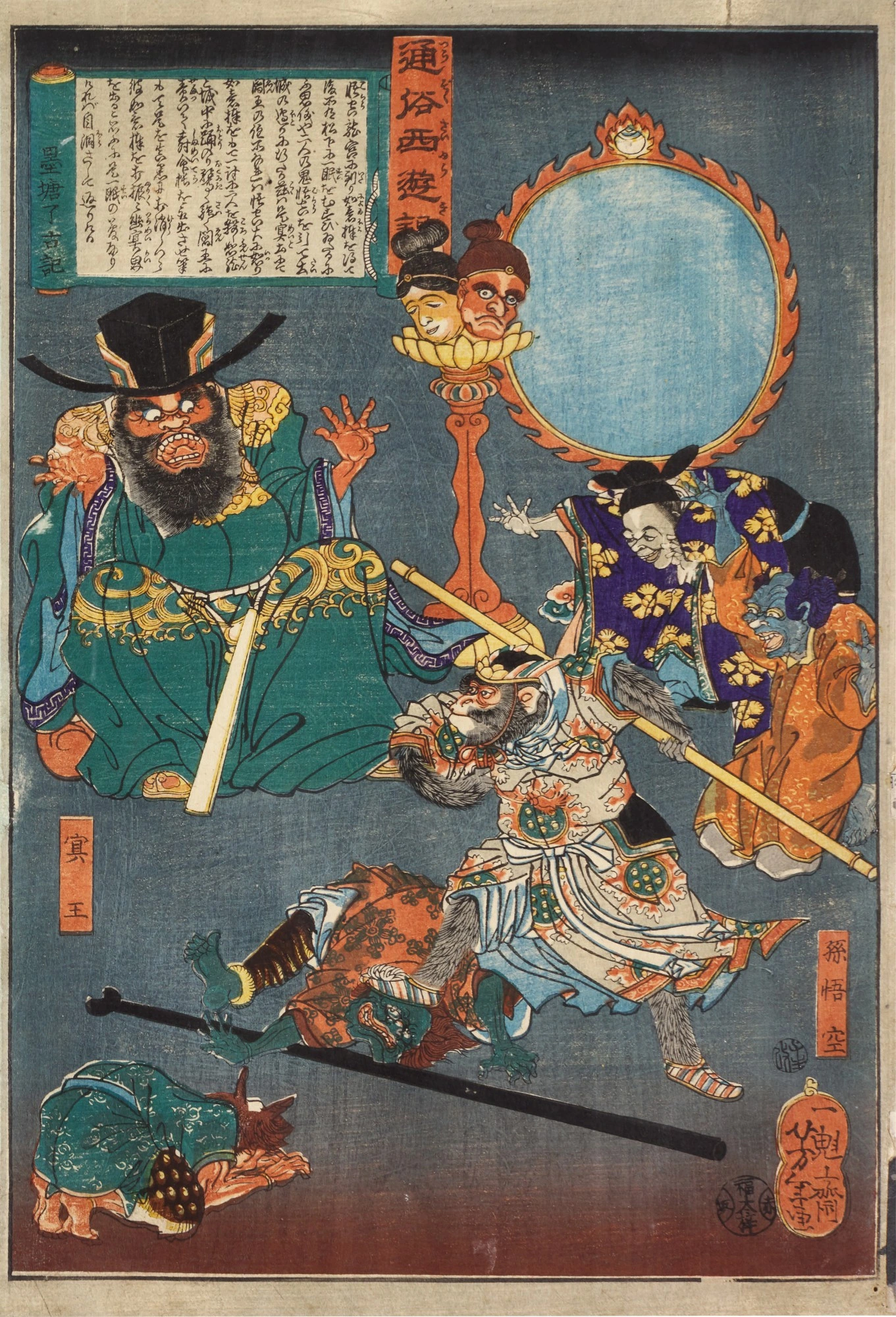 㝠王This persona's name translates (roughly) to 'Dark King'; he may be King Yama. Keyes describes the print to which he gave this number as "Monkey appears before the king of hell"; this print would appear to be the print he is referring to, except that the date on this one is clearly 1864/12, and he records the date of #2 as being 1864/11. Perhaps he simply made an error? Or perhaps this print has been mis-identified, and his #2 is possibly #16, or one of the others? It is also, of course, possible that he was referring to a print which we do not yet have an image of.VIEW PRINT ↗#2Son Gokū before the King of the Underworld1864/12
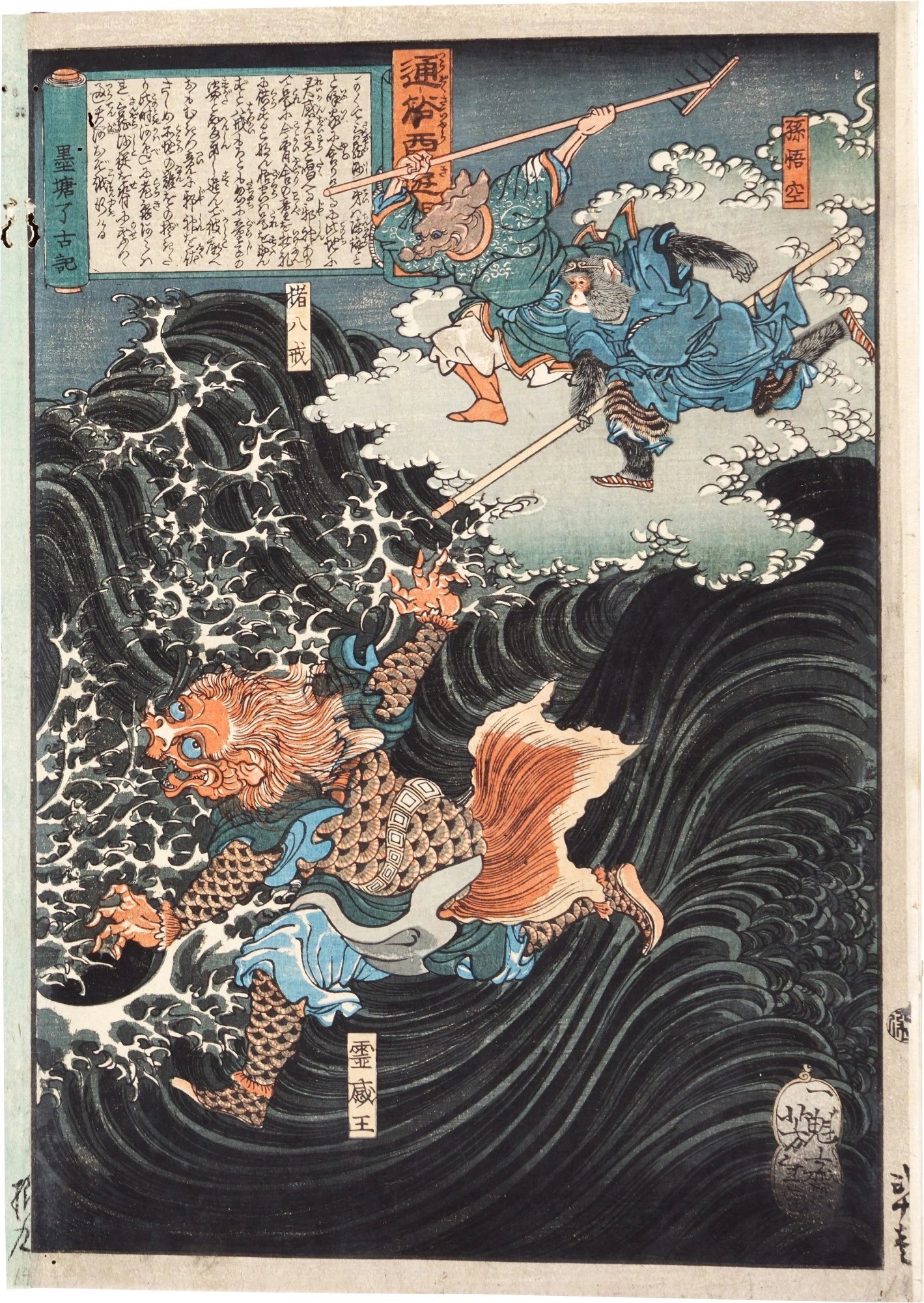 霊感王Reikanō is the King of Spiritual-Touch, a marine demon who is actually a gold-fish belonging to Guan-Yin, the Enlightened Immortal of compassion.VIEW PRINT ↗#3Son Gokū and Cho Hakkai Battle the Goldfish Demon1864/11
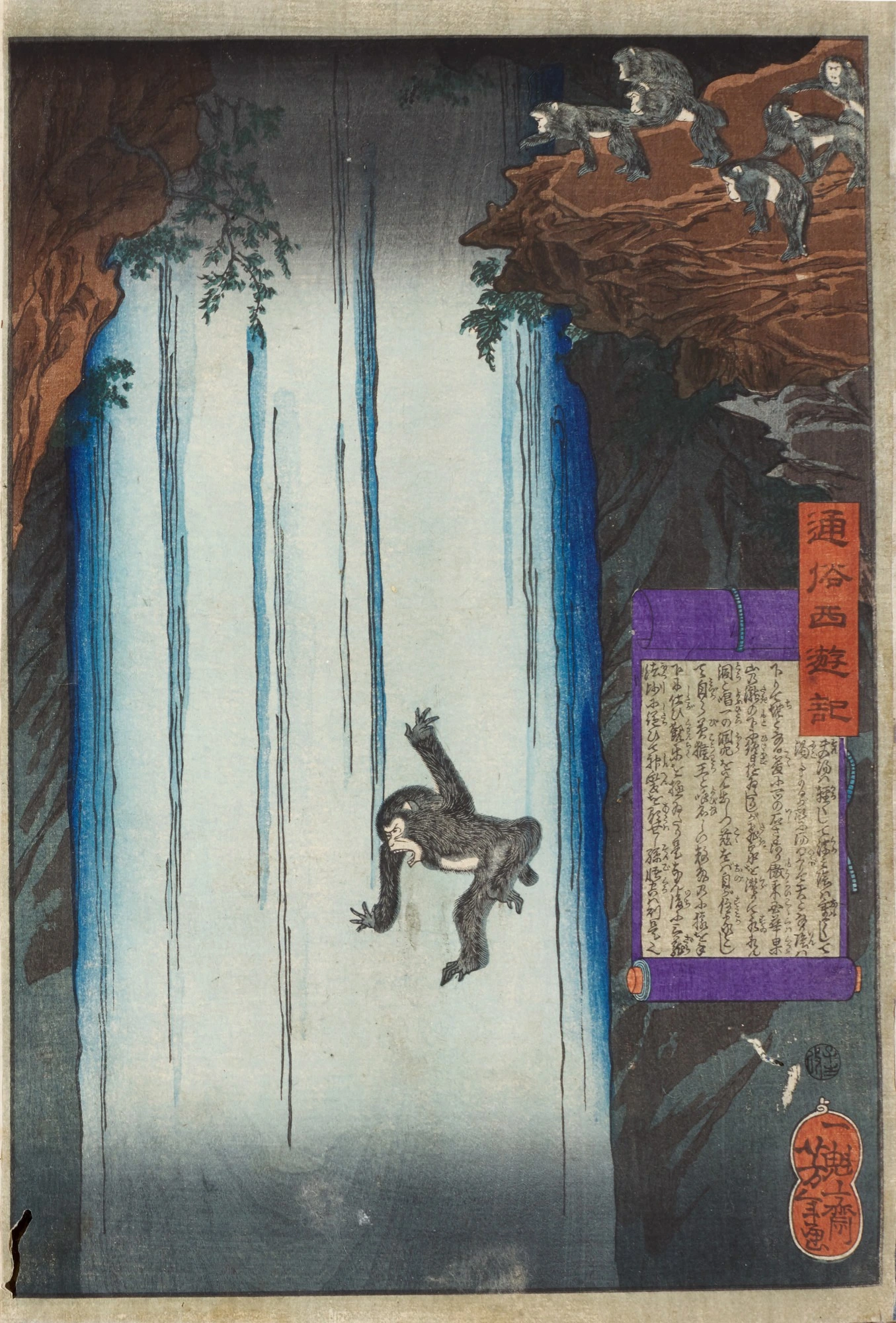 The waterfall shown here is probably the one on Flower Fruit Mountain behind which is the Water Curtain Cave, found by Son Gokū, where he and the tribe of monkeys he was originally the leader of live.VIEW PRINT ↗#4Son Gokū Leaps into the Waterfall1864/12
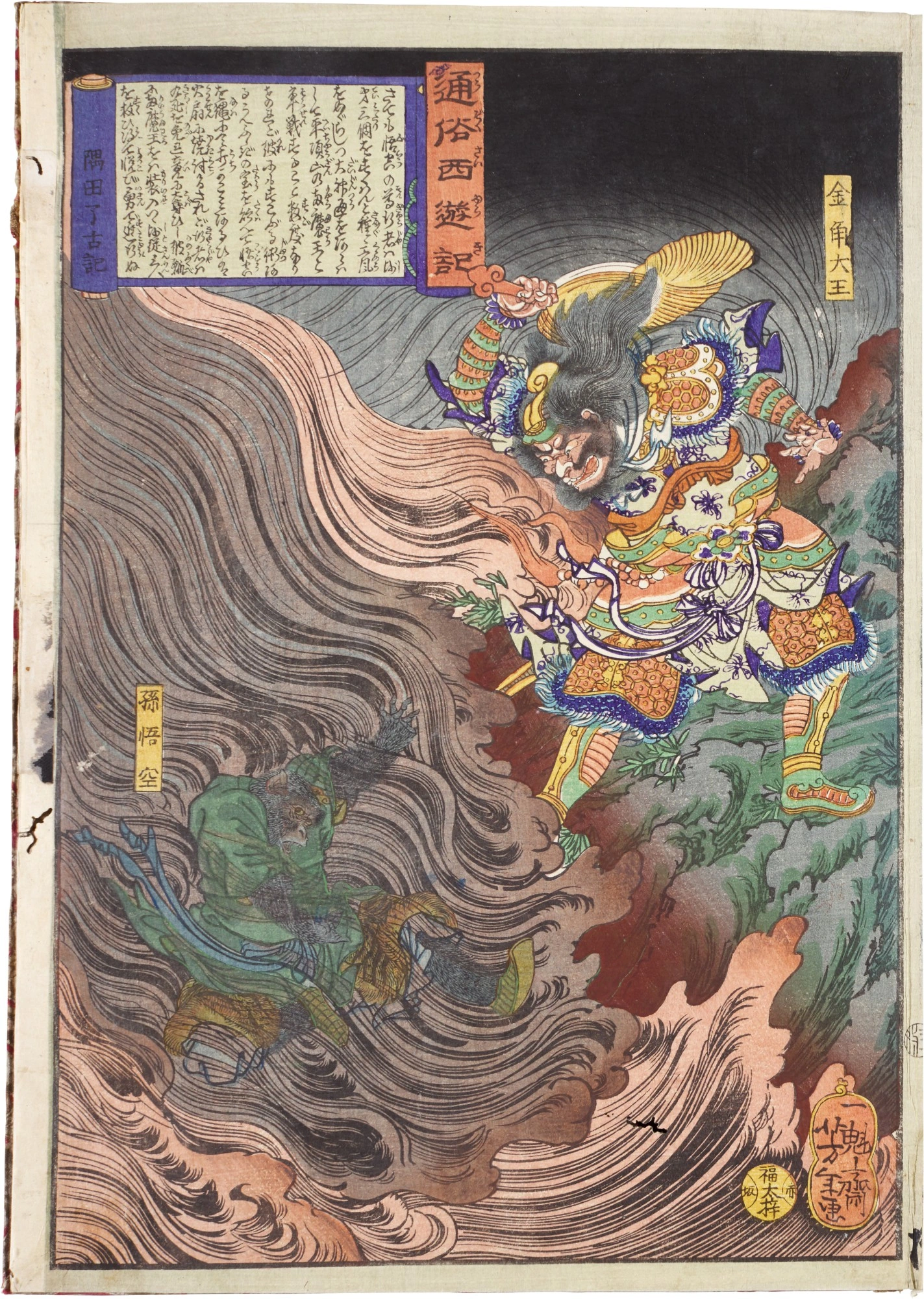 金角 大王This print illustrates an episode from the start of Chapter 33, where Son Gokū fights with a demon in order to free Cho Hakkai, whom the demon has captured. Kinkaku Daiō is the King of Gold Horn, an unruly servant of Laotzu, the ancient Chinese philosopher who is revered as a deity, "One of the Three Pure Ones", in Taoism.VIEW PRINT ↗#5Son Gokū Battles King Golden Horn1865/2
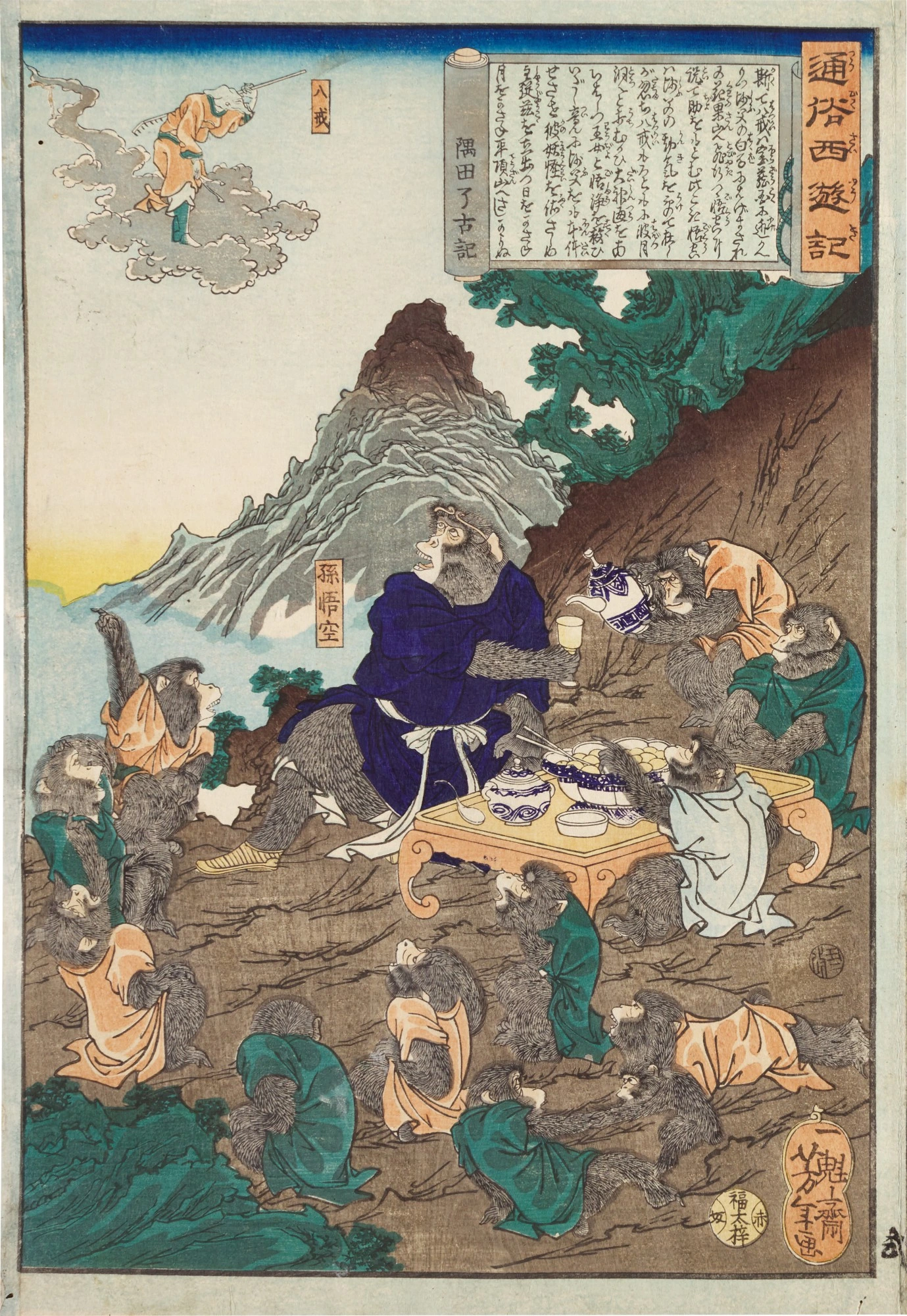 Cho Hakkai Finds Son Gokū on Flower-Fruit MountainVIEW PRINT ↗#6Cho Hakkai Finds Son Gokū on Flower-Fruit Mountain1865/2
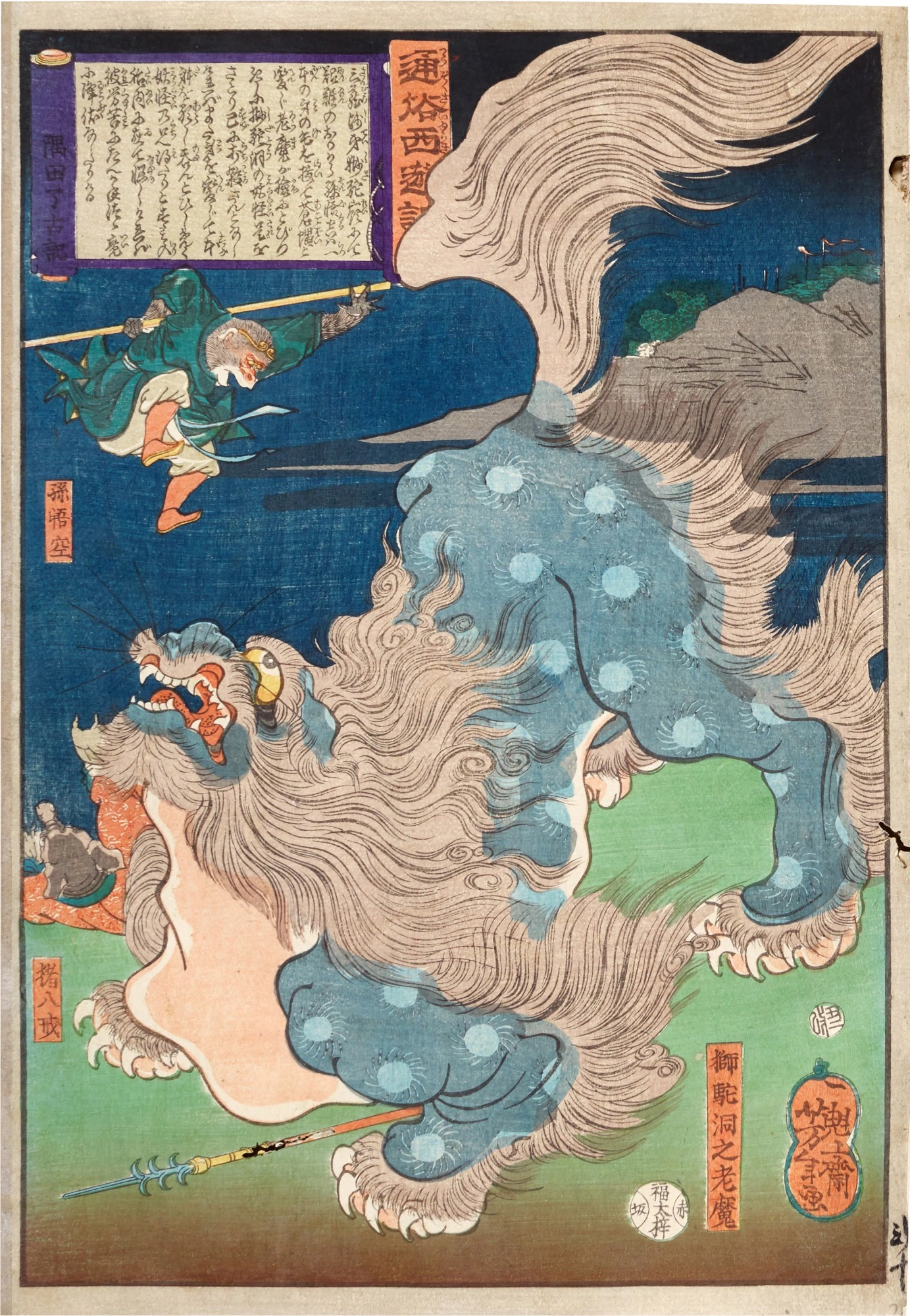 獅駝洞 之 老魔The identity of the mythical being is uncertain; its name translates to something like 'Ancient Demon of the Hunchbacked Lion Cave'.VIEW PRINT ↗#7Son Gokū and Cho Hakkai Battle the Old Demon of Lion-Camel Cave1865/2
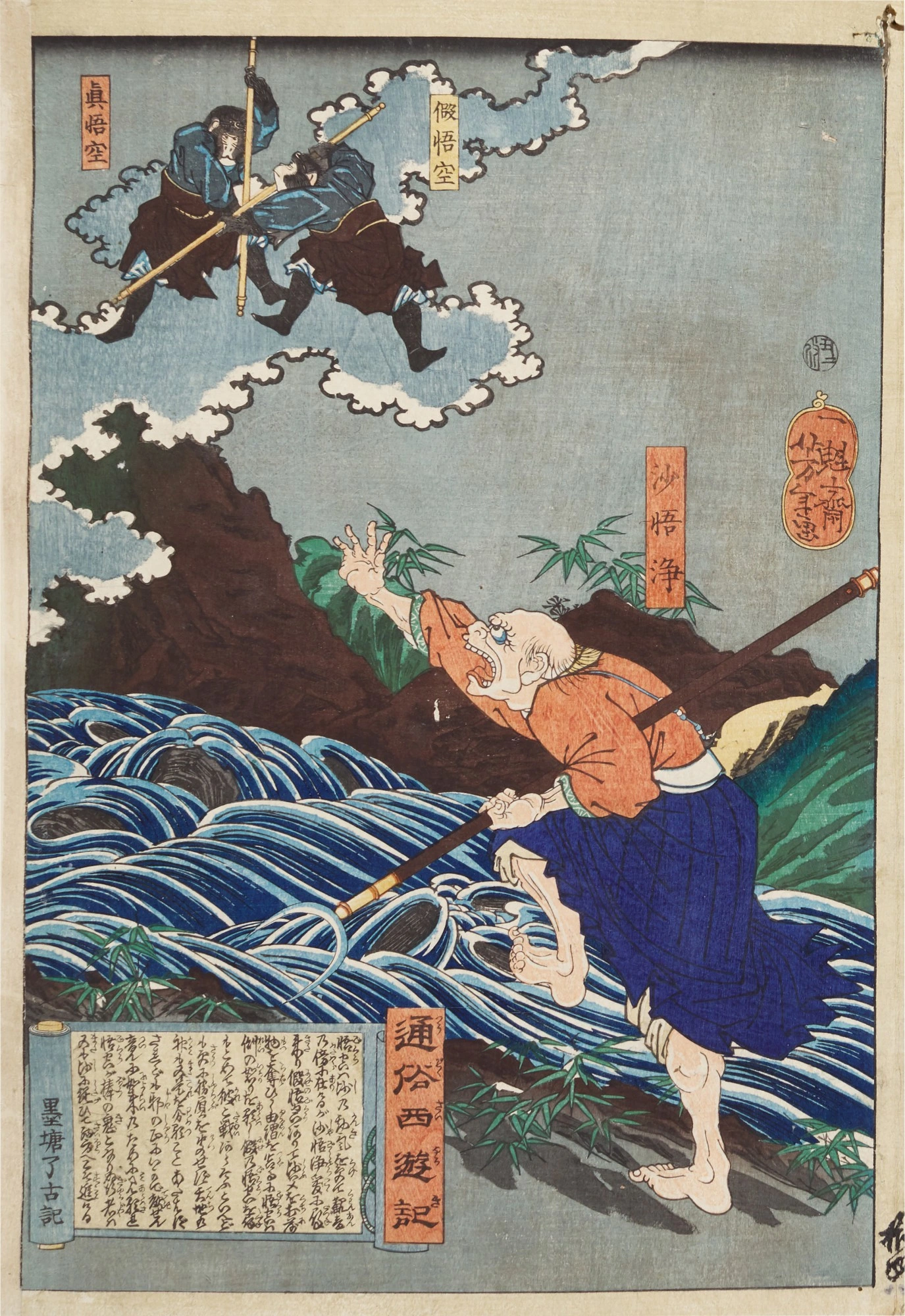 眞悟空 / 假悟空The True and False Son Gokū FightVIEW PRINT ↗#8The True and False Son Gokū Fight1865/2
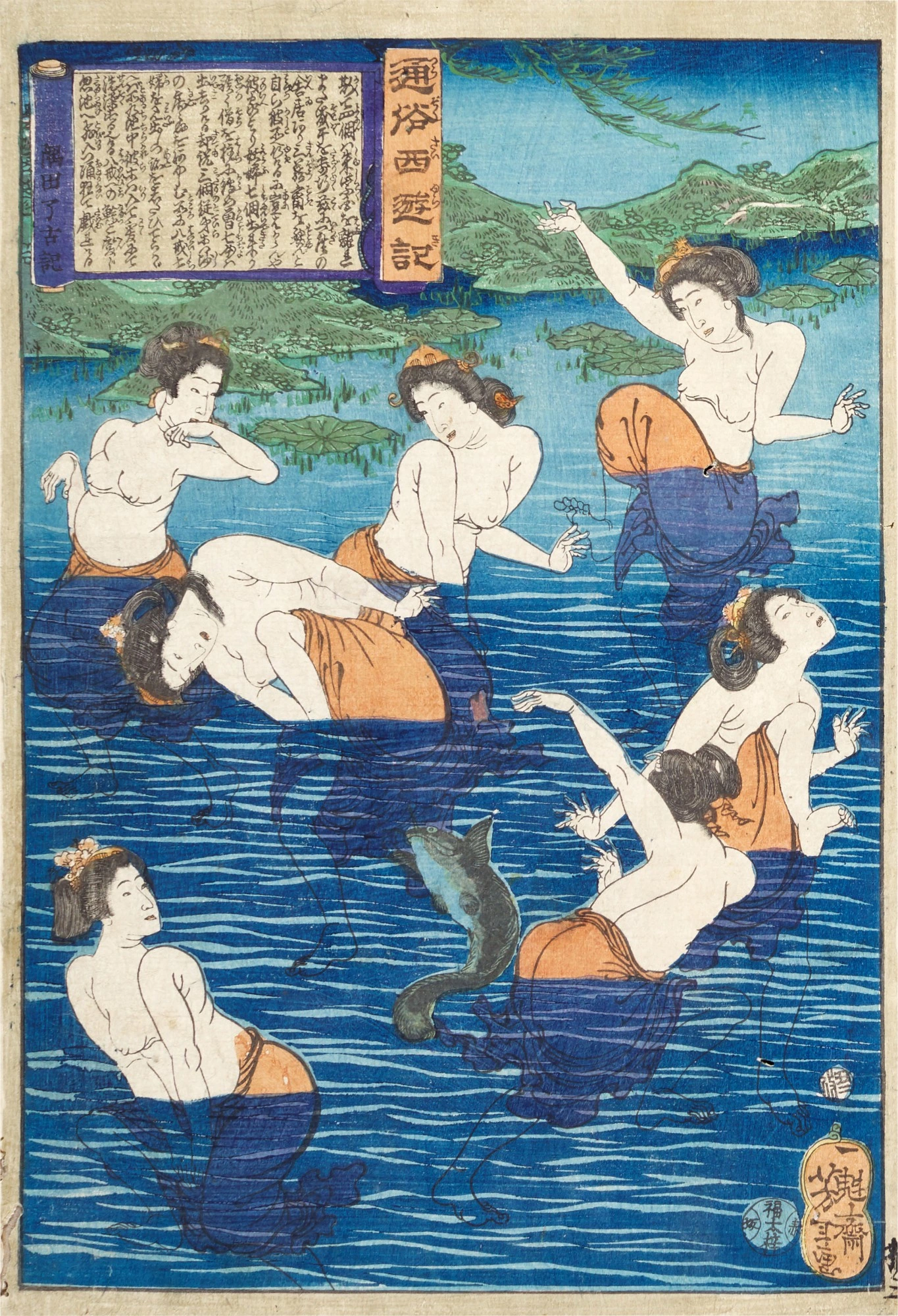 Cho Hakkai, Transformed into a Fish, with Seven Female DemonsVIEW PRINT ↗#9Cho Hakkai, Transformed into a Fish, with Seven Female Demons1865/2
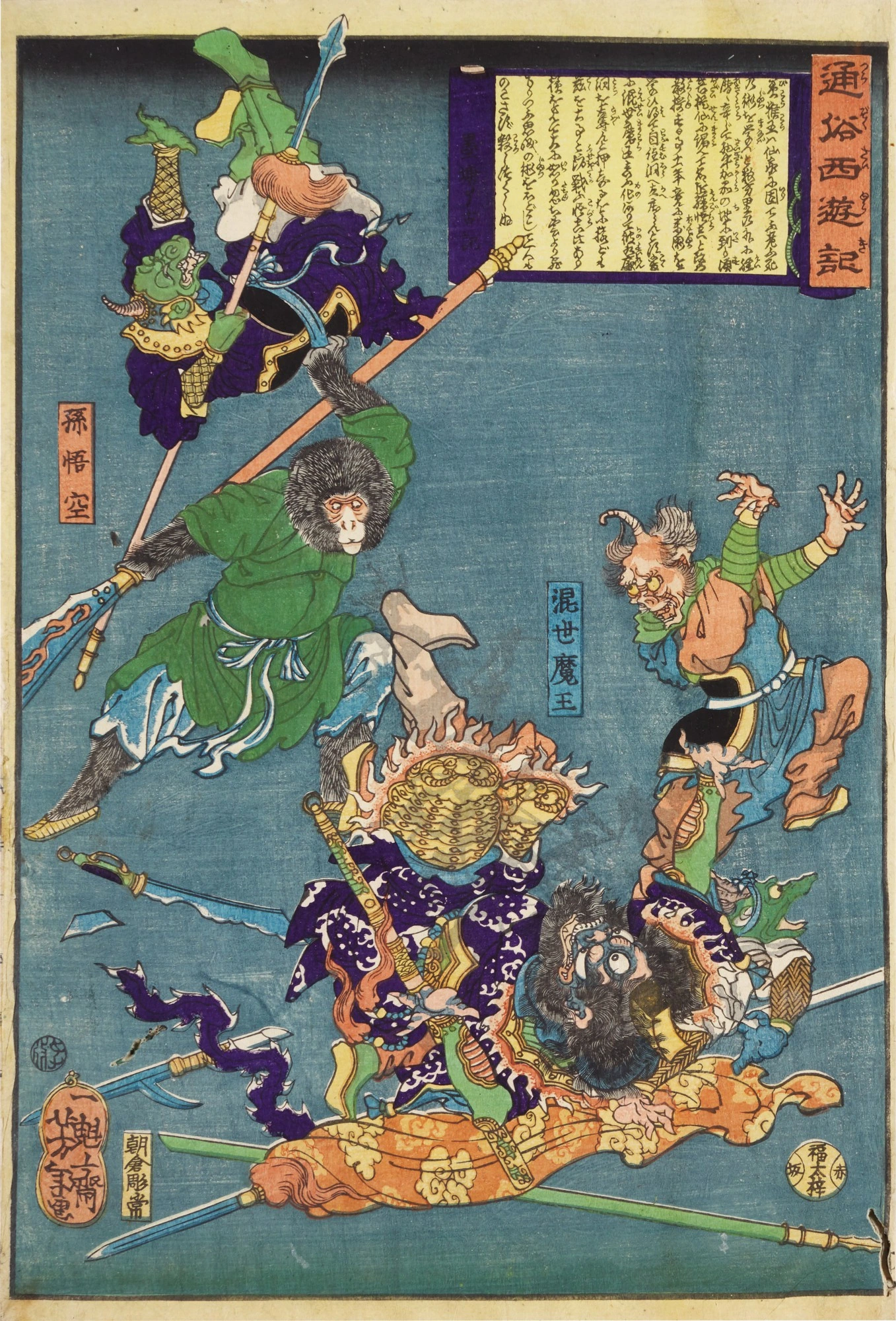 朝倉彫常 / 混世魔王This print illustrates an episode from Chapter 2; Son Gokū battles a demon who has captured the cave where Son Gokū and his tribe of monkeys live. It is not known who or what the first cartouche refers to. The second is the Demon King of Confusion.VIEW PRINT ↗#10Son Gokū Defeats the Demon King of Havoc1864/10
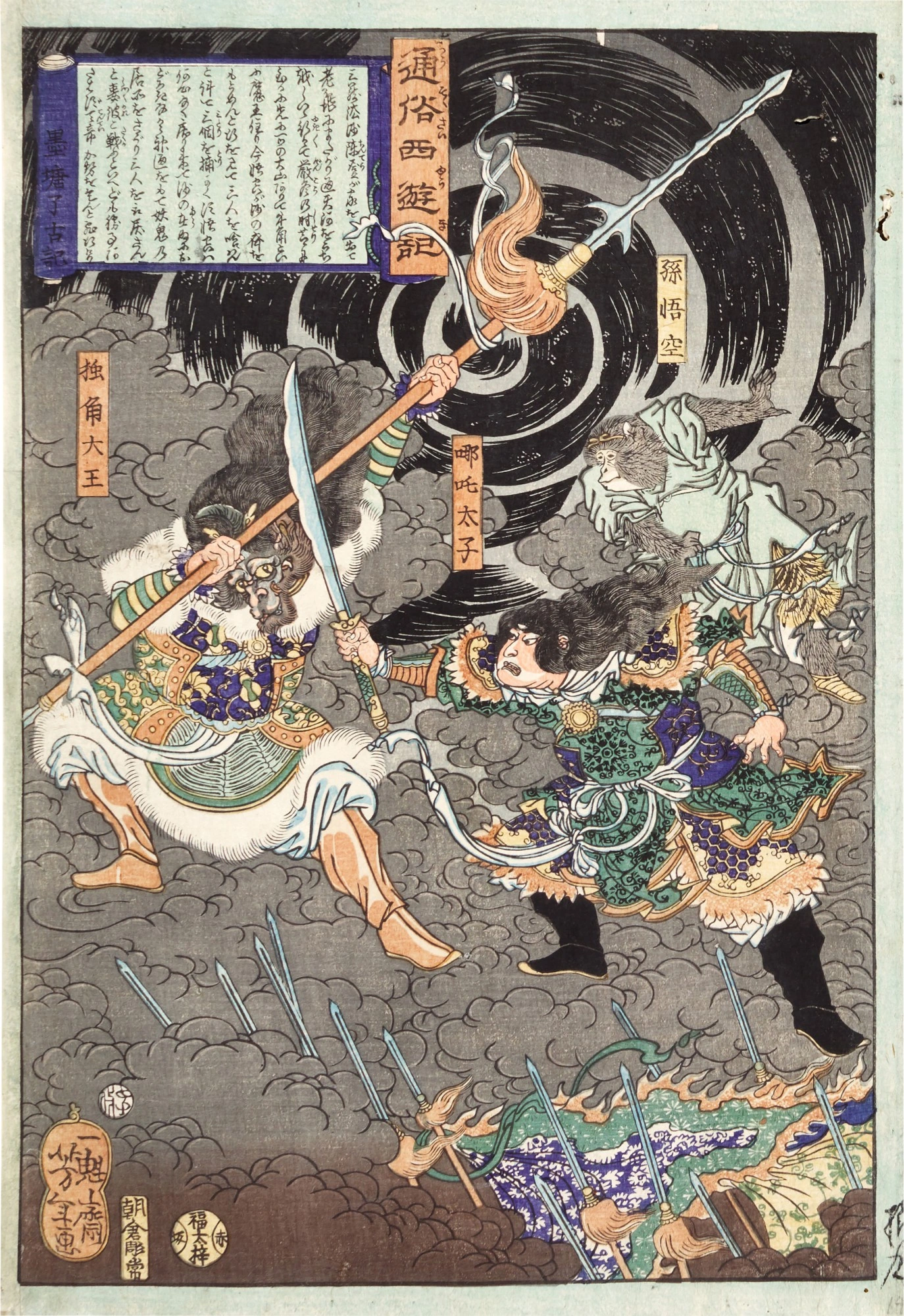 独角 大王 / 哪吒 太子The first name translates to a character who is unidentified; his name translates to "King Single Horn", so he may be the character named 'One-horned Demon King', who appears in Chapter 5. The second is Prince Nata (Prince Ne Zha in Chinese).VIEW PRINT ↗#11Prince Nata Battles the One-Horned Demon King1864/10
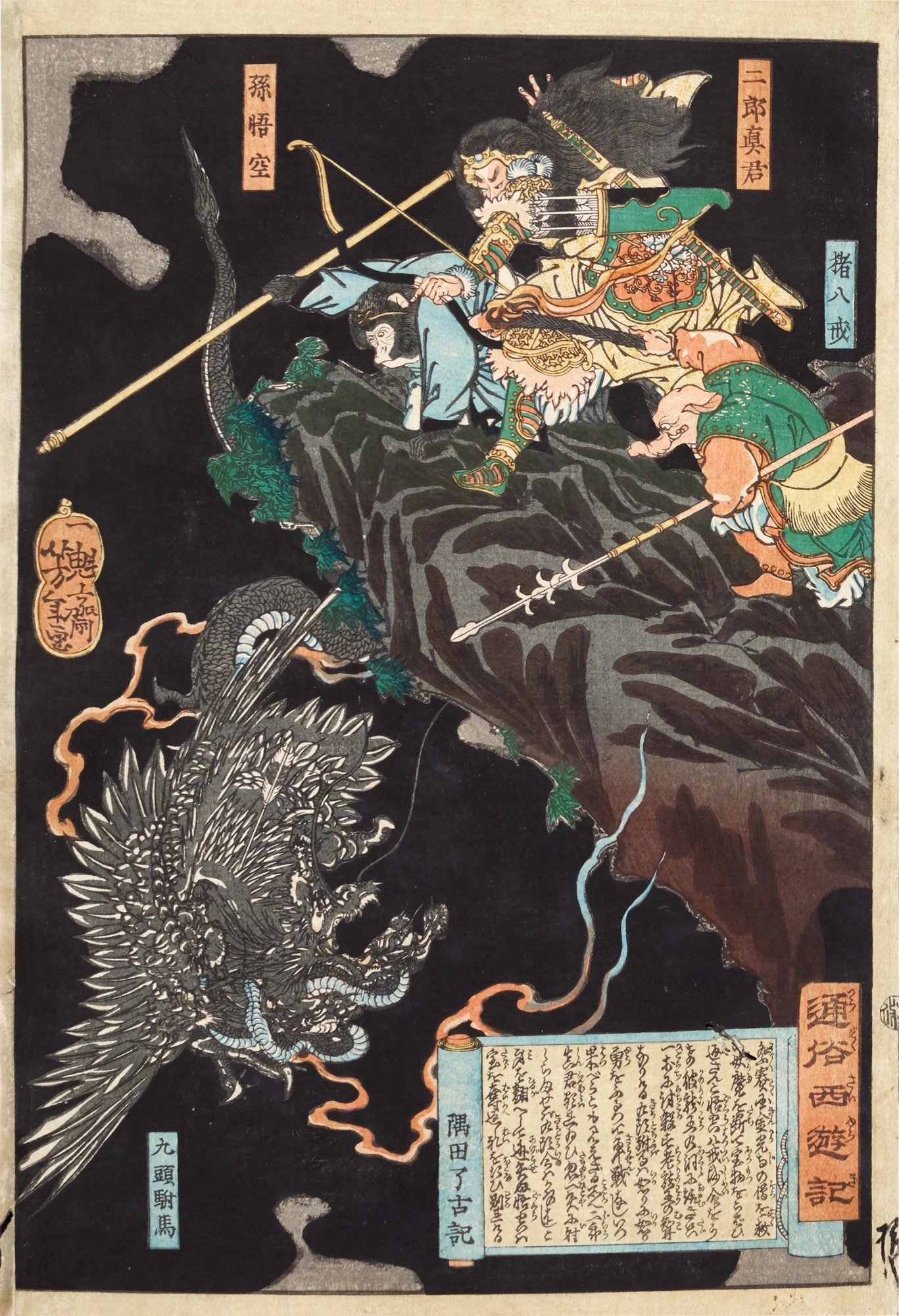 二郎 真君 / 九頭駙馬This print illustrates an episode from Chapter 63; an old adversary of Son Gokū helps the travellers in a fight with a powerful demon. Although the reading of the characters in these names not certain for all of them, the actual personae shown are definitely identified. The first, called True Lord in English, is the persona named Erlang Shang in Chinese. The other is the Nine-Headed Demon, who is the son-in-law of the Dragon King of Azure Lake.VIEW PRINT ↗#12Son Gokū, Cho Hakkai, and Erlang Battle Nine-Heads1864/12
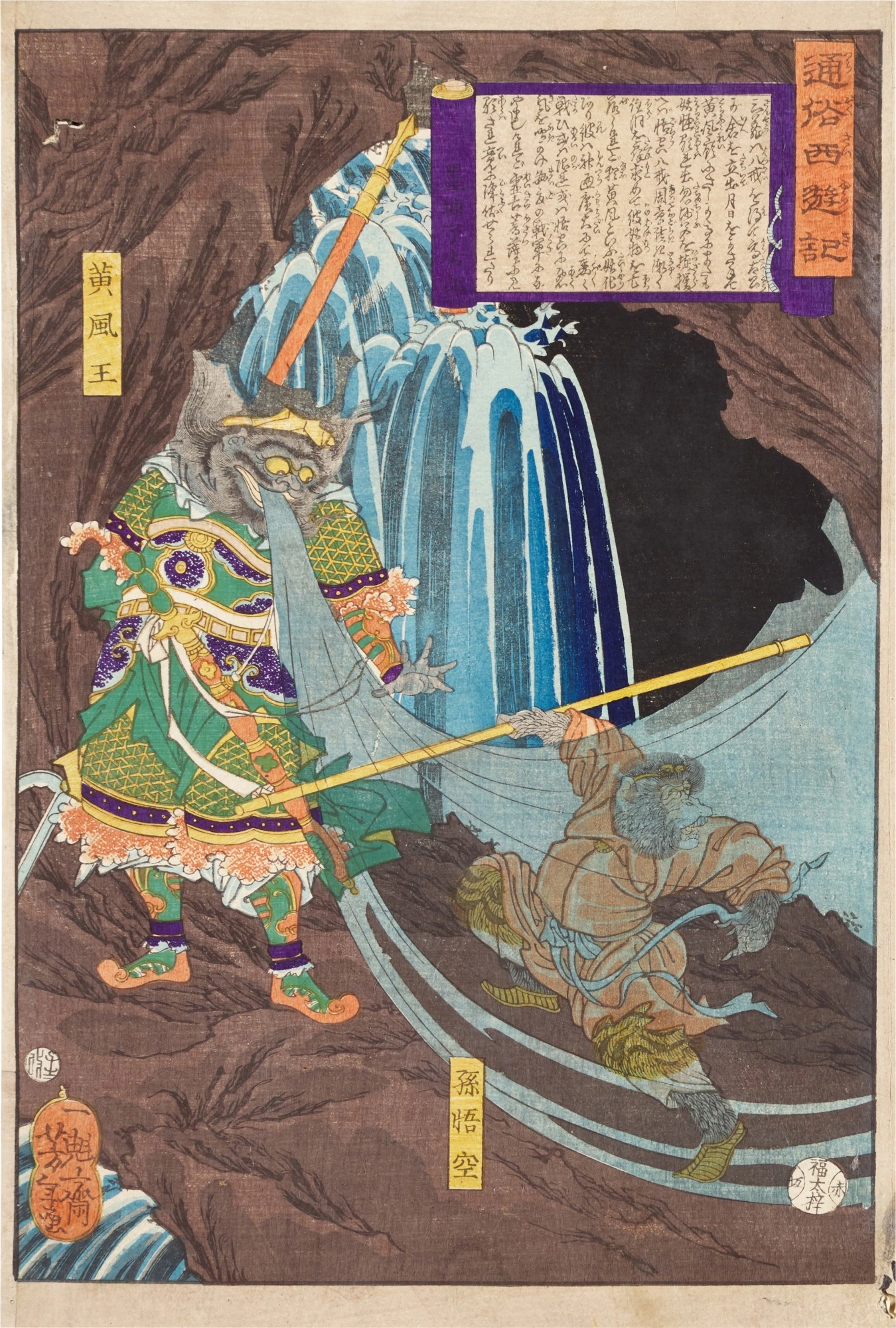 黄風王This print illustrates an episode from Chapter 21, where Son Gokū fights with a wind demon in order to free Genjō-sanzō, whom the wind demon has captured. This is the Demon of Yellow Wind (although his name in Chinese is written with slightly different characters than the ones used here, as do many of the figures in this series).VIEW PRINT ↗#13Son Gokū Battles the Yellow Wind King1864/12
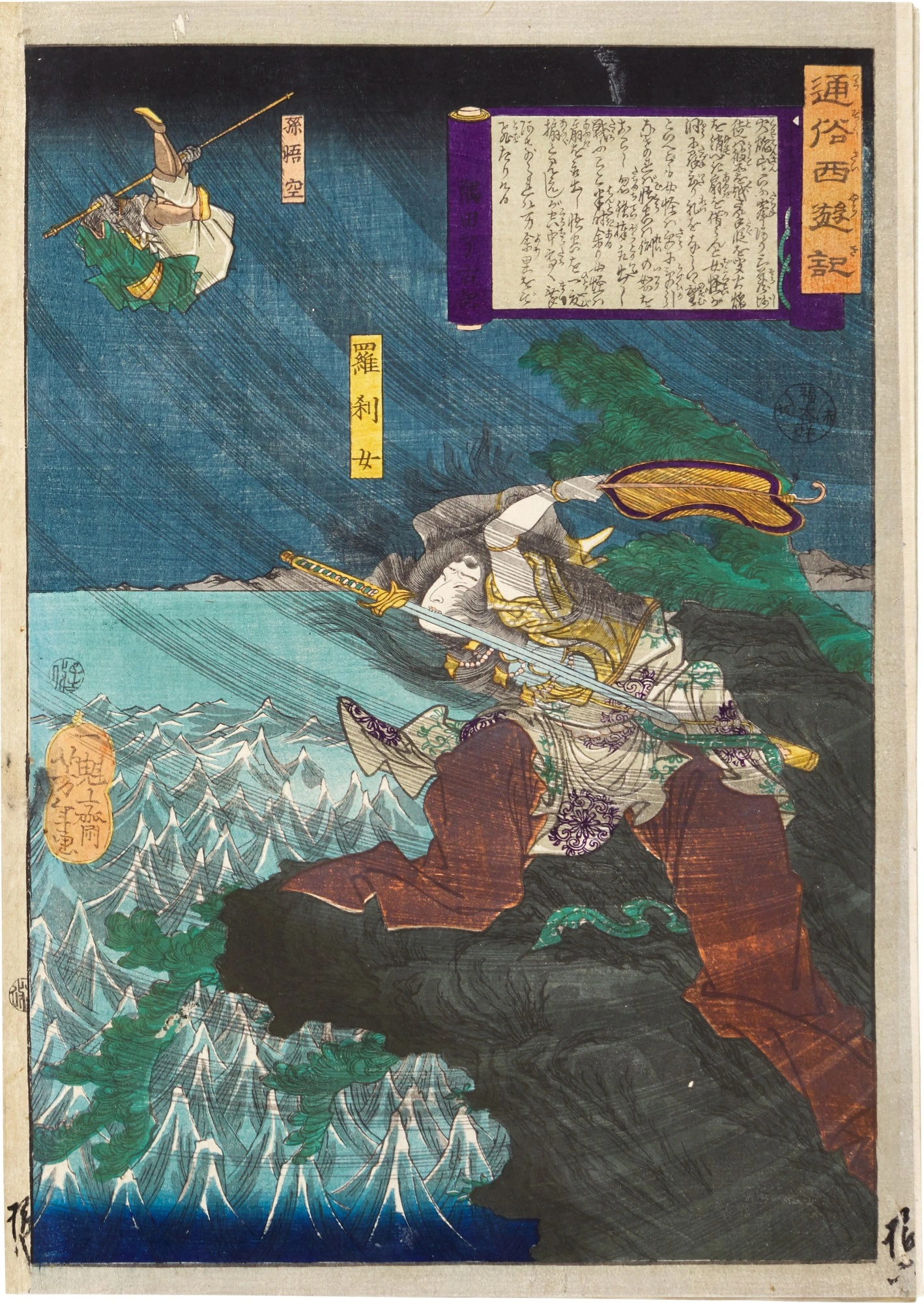 羅利女The warrior in this print is unidentified, and the reading of his name is uncertain.VIEW PRINT ↗#14Son Gokū Battles the Demoness Rākṣasī1864/12
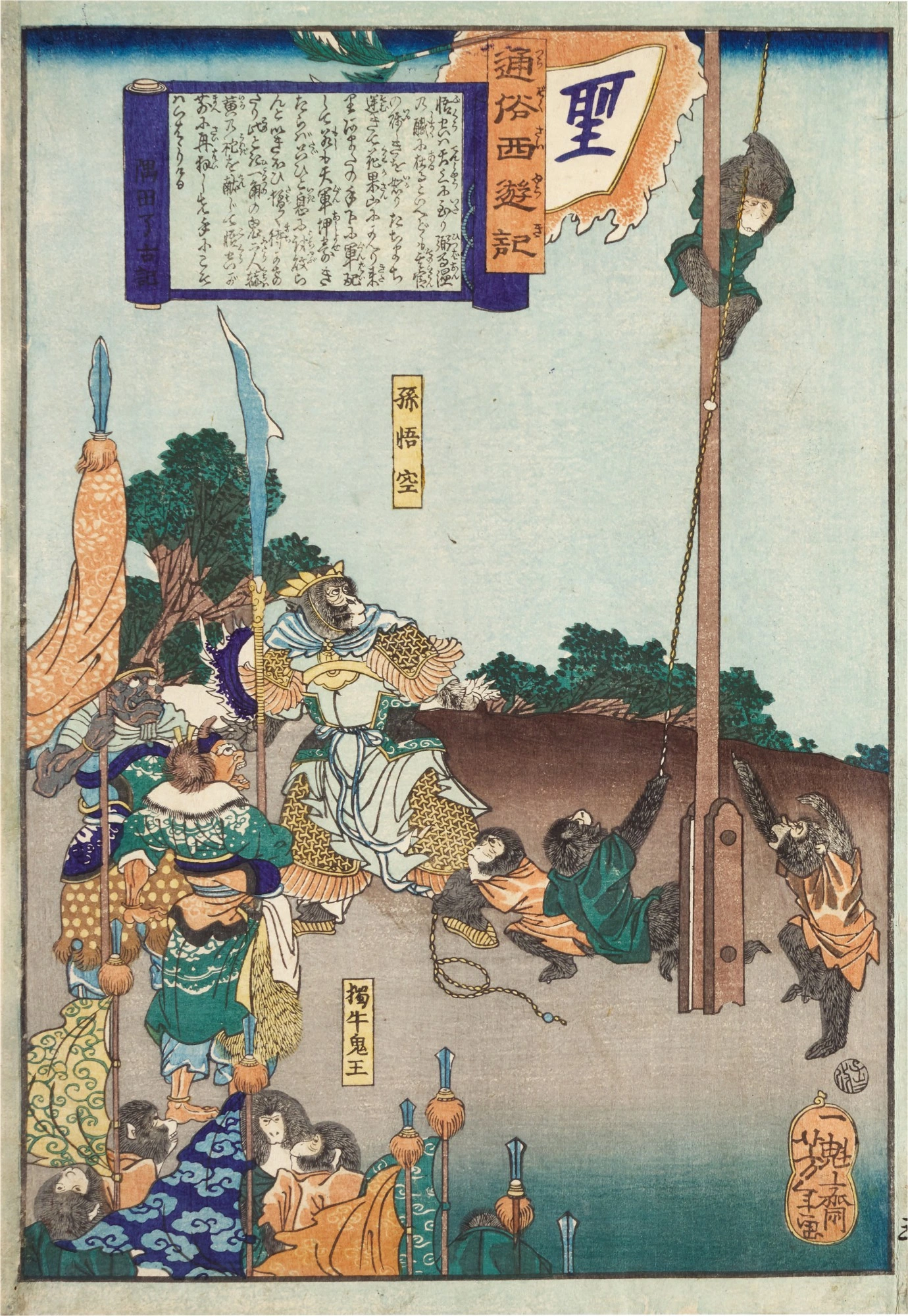 獨牛鬼王The demon in this print is the Ox Demon King, who at one point had been Son Gokū's sworn brother. The leading Doku seems to mean something like "the only". His name is normally always (including in Japanese) written with a different second character for 'demon', 魔, and the name with that character is read Gyūmaō.VIEW PRINT ↗#15Son Gokū and the Bull Demon King1864/12
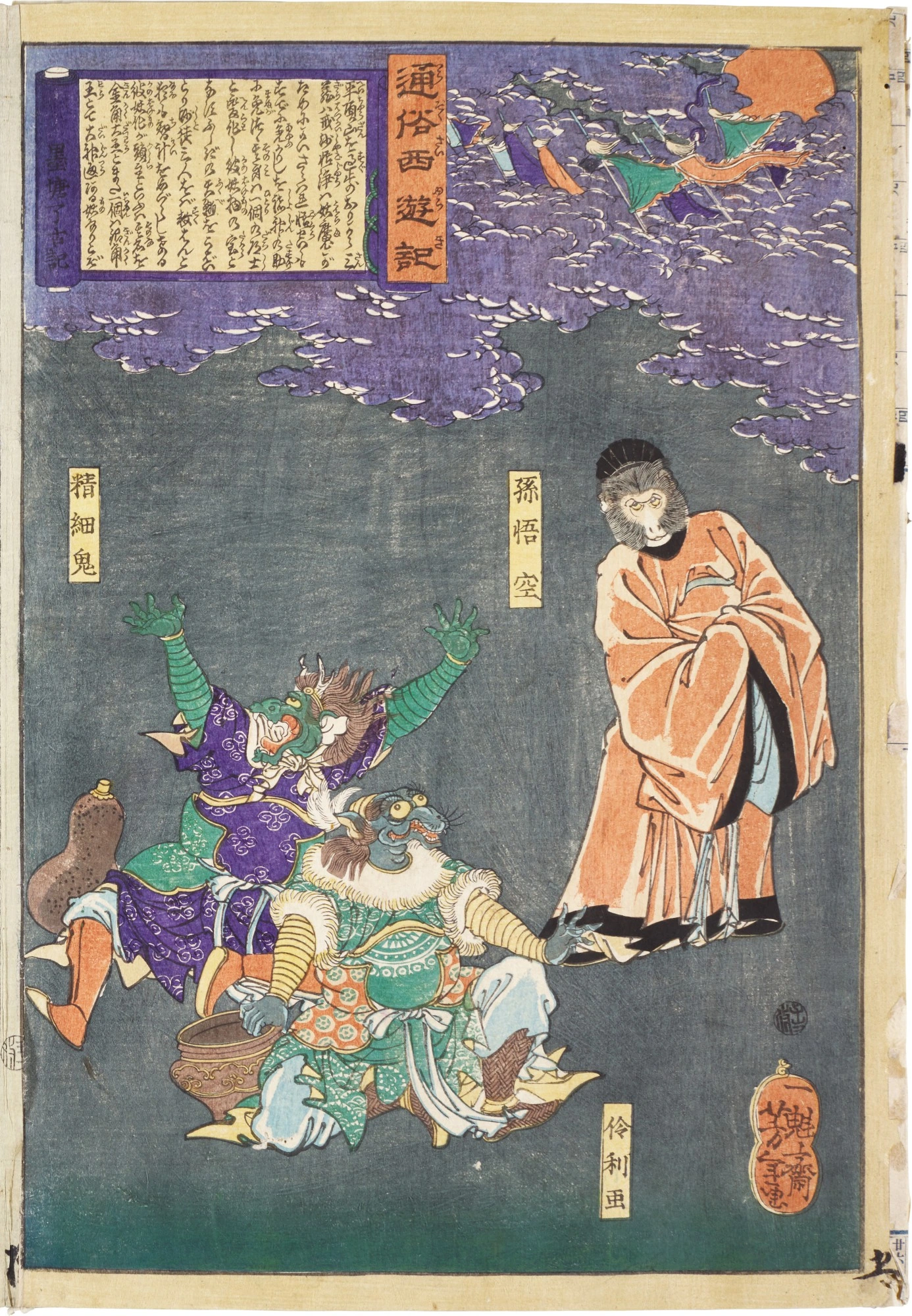 精細鬼 / 伶利䖝The identity of these two demons is not known, but the readings for their names are correct. The name of the second demon is normally always (including in Japanese) written with the characters 伶俐虫 (with the same reading).VIEW PRINT ↗#16Son Gokū Tricks Sly Devil and Wily Worm1864/12
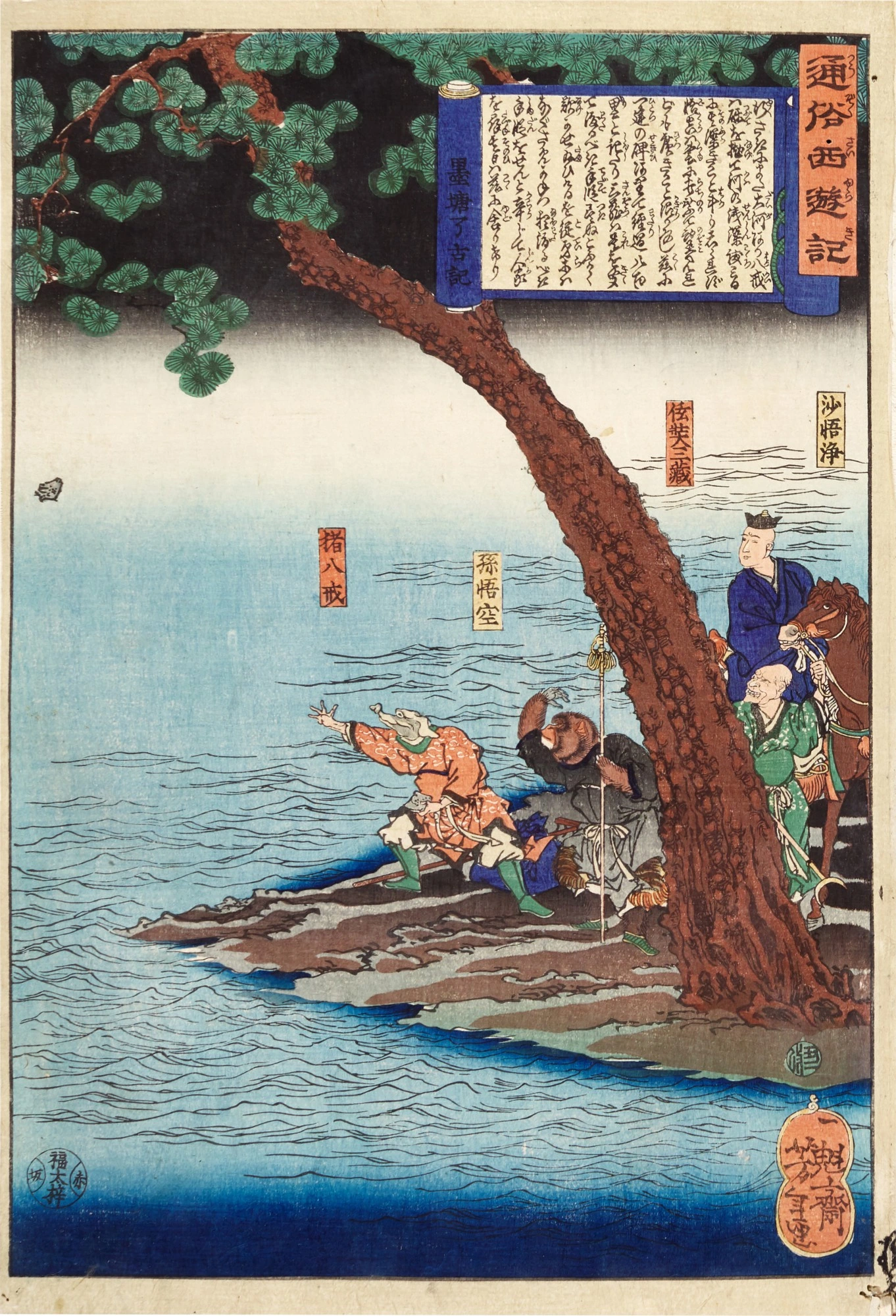 Cho Hakkai Throws a Pebble into the Heaven-Reaching RiverVIEW PRINT ↗#17Cho Hakkai Throws a Pebble into the Heaven-Reaching River1865/2
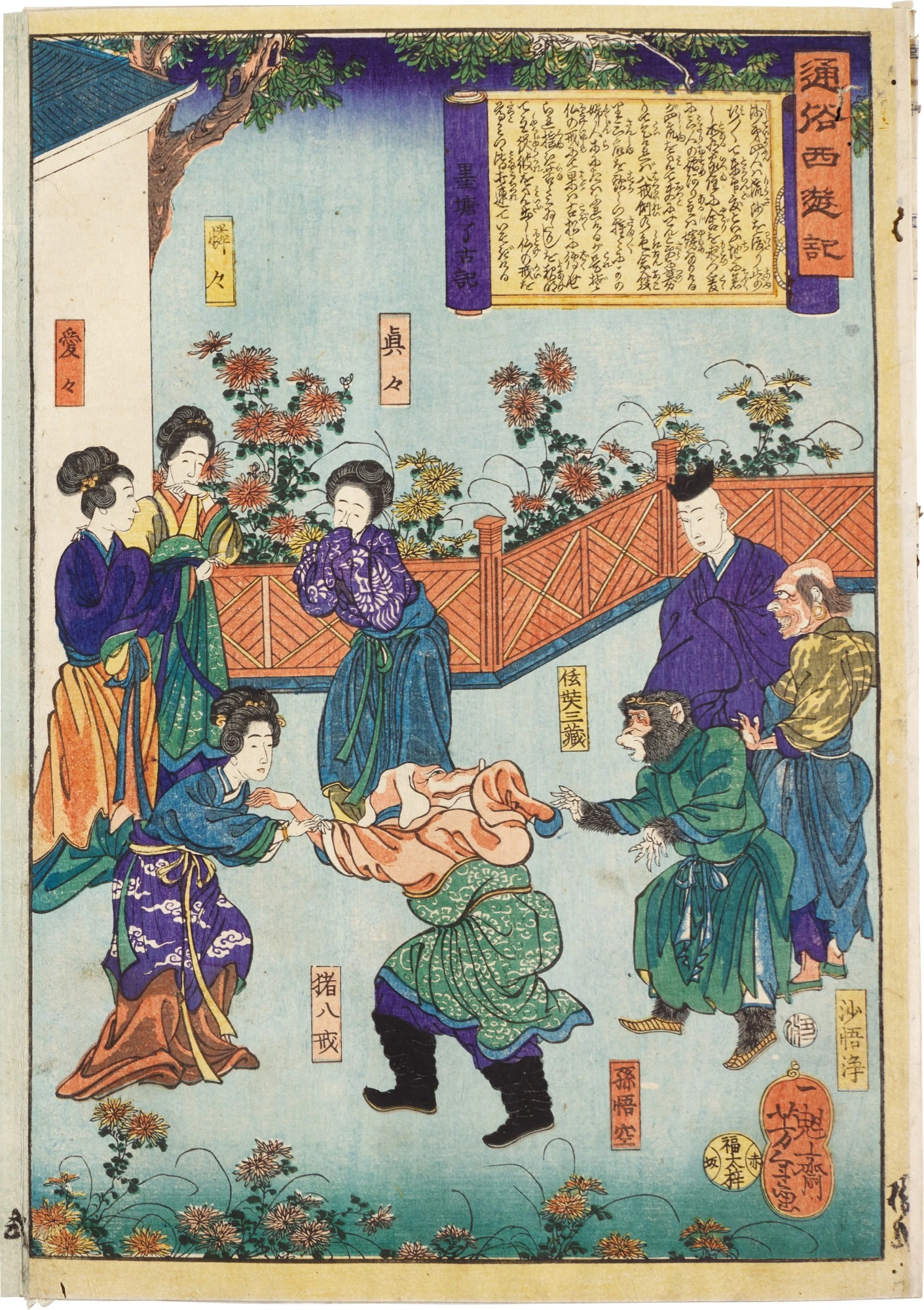 愛々 / 憐々 / 眞々This print illustrates an episode from Chapter 23; the travellers are tested by goddesses masquerading as a mother and her three daughters. The reading of the names is not entirely certain; in Chinese they are Ai-Ai, Lian-Lian and Zhen-Zhen. The first syllable of Genjō's name seems to have been written with the non-standard character 伭, and Cho Hakkai's with the character 猪.VIEW PRINT ↗#18Cho Hakkai Agrees to Marry One of Three Sisters1865/2
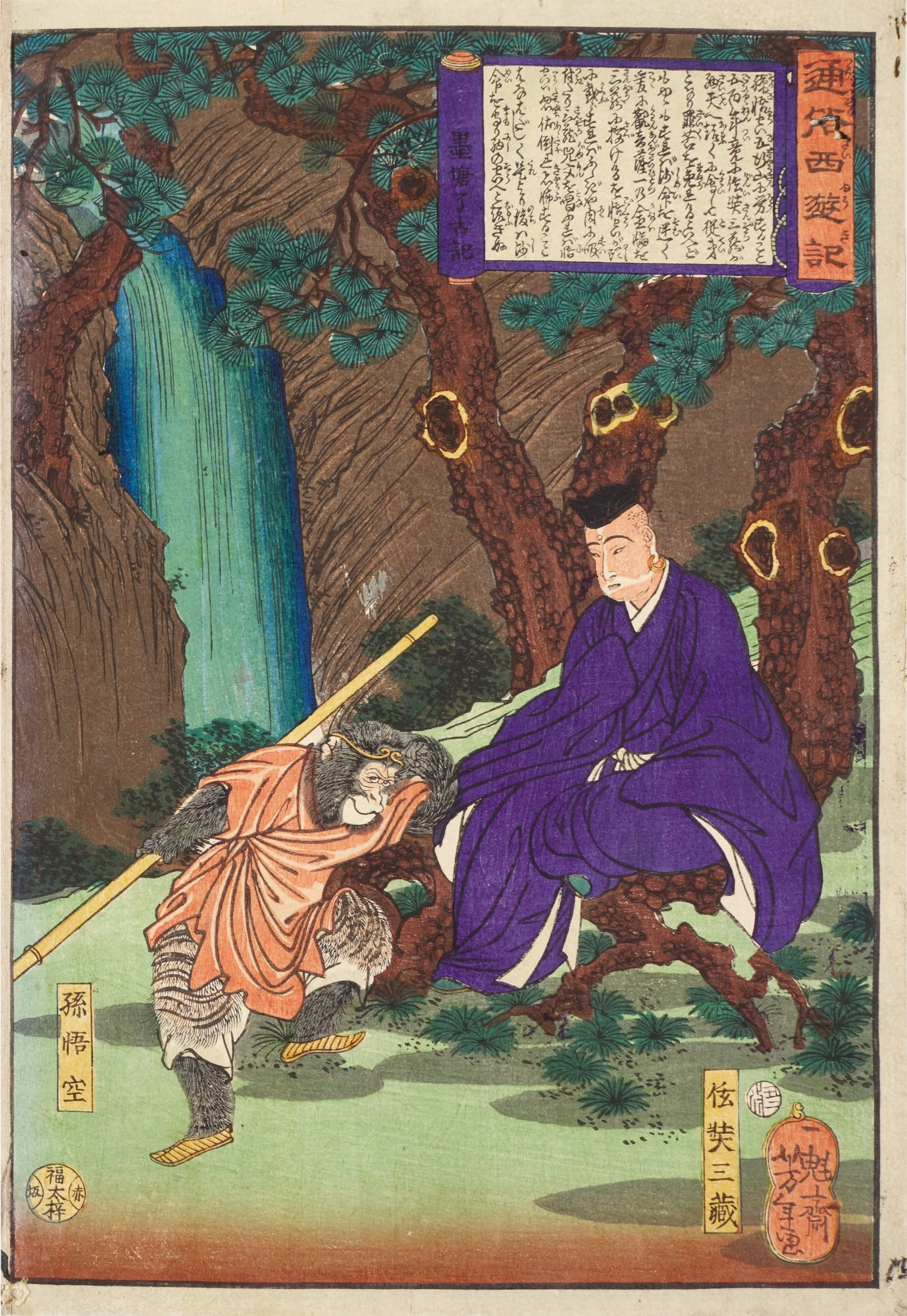 Tripitaka Places the Golden Headband on Son GokūVIEW PRINT ↗#19Tripitaka Places the Golden Headband on Son Gokū1865/2
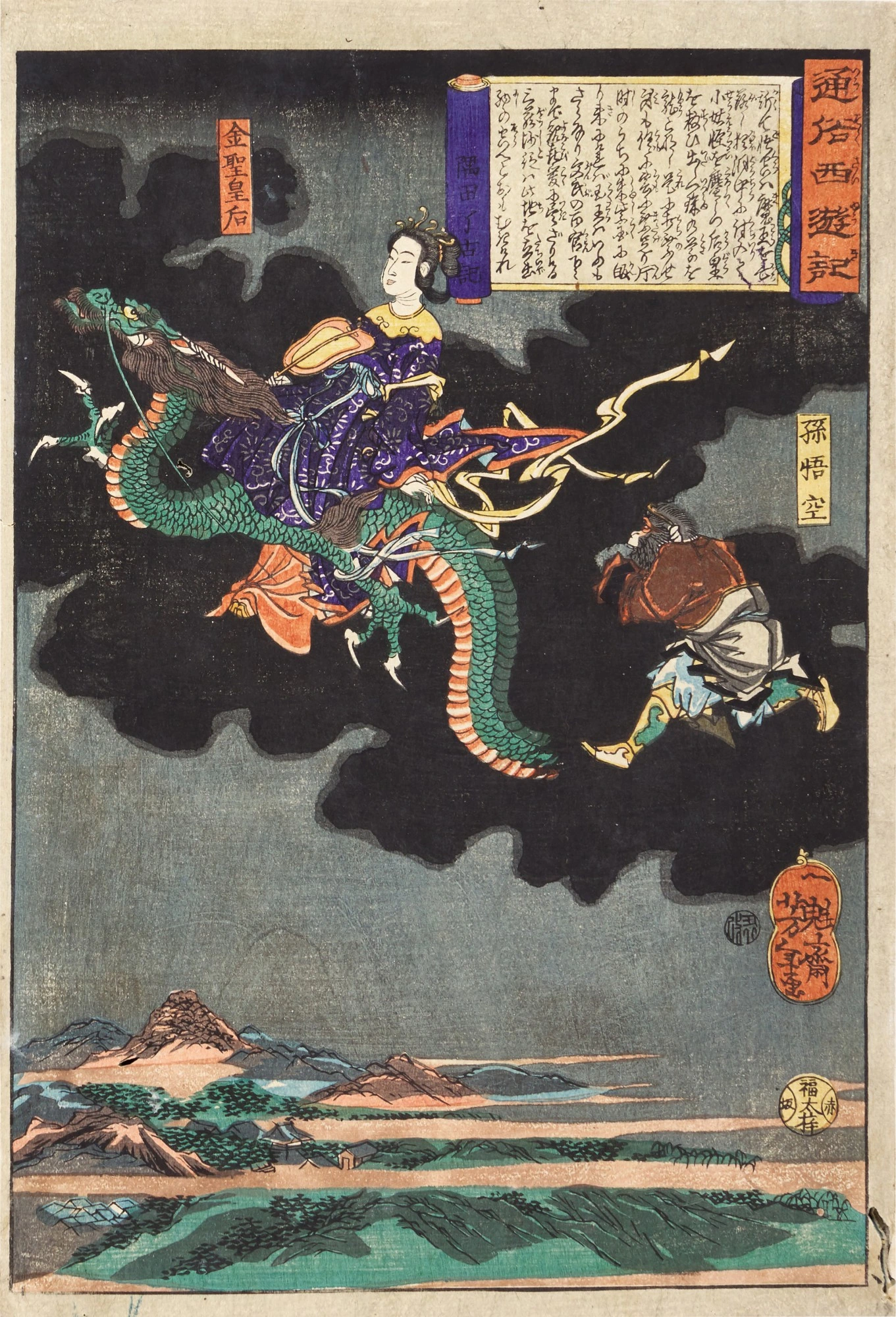 金 聖 皇后Another mythical persona whose identity is uncertain; her name translates to something like 'Empress Gold Nun'.VIEW PRINT ↗#20Son Gokū Returns Queen Golden Sage Home on a Straw Dragon1865/8
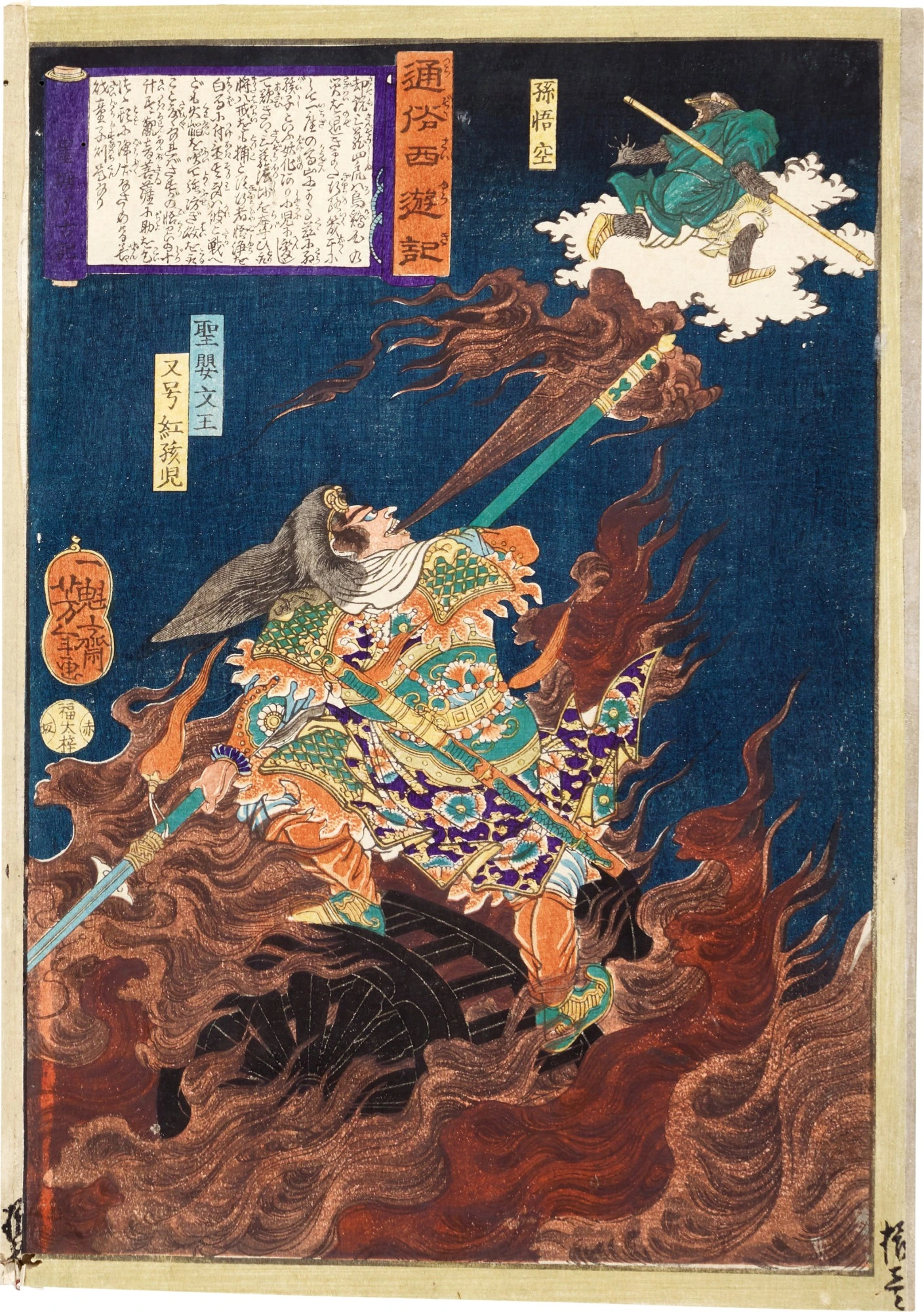 聖嬰文王 / 紅孩児The mythical being shown here is the Boy Sage King, who is also known by the nickname Red Boy; the two cartouches give his name and nickname. The second cartouche starts with the characters 又 号 (mata gō), which mean, roughly, 'other sobriquet'. There is almost certainly an error in the third character of the first cartouche, as his name is usually written with the character 大, not 文 as here. This variant is seen nowhere else, except this print; the reading with the usual character is Seiei Taiō.VIEW PRINT ↗#21Son Gokū Battles Red BoyNo date seal?
Prints 1–9 follow Keyes; later entries retain the source page’s extensions. The prints themselves are unnumbered.
About the Series
This page attempts to catalog all known prints in
Yoshitoshi's series 'Tsūzoku saiyūki (通俗 西遊記 - A Modern "Journey to the West")'. The 'Journey to the West' in one of the classic novels of Chinese literature; it is a unification of a number of supernatural myths and legends about the pilgrimage of famous Chinese Buddhist monk named Xuanzang to India (then known as the Western Regions), at the time of the Tang Dynasty, in order to collect a number of Buddhist religious texts.The series dates from the start of Yoshitoshi's career, when he was about twenty-five. It thus dates from about two decades before his well-known masterpieces, such as his great series "One Hundred Aspects of the Moon" (1885-1892), and "New Forms of Thirty-Six Ghosts" (often called simply "Thirty-Six Ghosts") (1889-1892).
According to Keyes, the text in the cartouches is by Sumida Kurozato (Kokutō) Ryōko.
Main characters
The prints include small cartouches labelling the personae (the term 'persona' is used throughout, to avoid confusion with the term 'character', which is used to mean
'ideogram' throughout the site) shown in each print. Some of the main personae, whose names appear again and again, are listed here. Listed right after the monk are four companions and protectors of the monk, who acted as disciples, who were assigned to him to help him with his task.- 玄奘 三藏 - Genjō-sanzō - The monk Xuanzang (Xuanzang-sanzang in Chinese - the second part of the name literally means "Three Baskets [of Buddhist teaching]"); he is drawn as a younger monk, with a mark on this forehead, often astride a horse (see below)
- 孫悟空 - Son Gokū - The Monkey God or Monkey King (Sun Wukong in Chinese); the most intelligent and powerful of the companions, he is always drawn as a monkey
- 豬 八戒 - Cho Hakkai - Pigsy (Zhu Bajie in Chinese - literally, "Eight-Precepts Pig" or "Pig of the Eight Prohibitions"); he is always drawn as a pig (although the shape of his snout looks more like an alligator than that of a modern farm pig)
- 沙 悟淨 - Sa Gojō - Sandy or Friar Sand (Sha Wujing in Chinese - literally, "Sand Awakened to Purity"); he is drawn as an old monk
- 玉龍三太子 - ? - The Third Prince of the Dragon-King (Yulong Santaizi in Chinese); usually drawn as a white horse, ridden by Genjō-sanzō
Publication details
- Dates: 1864 (10) - 1865 (8)
- Size: Ōban
- Signed: Ikkaisai Yoshitoshi
- Publisher: Fukuta
Catalogue references and numbering
Prints 1–9 follow Keyes; later entries retain the source page’s extensions. The prints themselves are unnumbered.
The only known attempt to enumerate this series is in Keyes' thesis:
	Roger. S. Keyes, "Courage and Silence: A Study of the Life and
		Color Woodblock Prints of Tsukioka Yoshitoshi 1839-1892",
		Cinncinnati, 1982
where it appears as series #116.
Keyes listed 9 prints in the series; we have probably found an additional 12 prints, making 21 in total. (The uncertainty is because is a slight question about one of the prints that Keyes lists; if the one we have for that one is not the one we think it is, we will have found 13 additional prints.) We use the Keyes numbers for the first 9, and have numbered the rest in the order of their dates, as Keyes did for the first nine.
The prints in the series do not appear to have any titles, or have numbers on them, or otherwise be in any explicit order. Japanese museums which have prints on display from this series do not show titles for the prints, merely list the personae which are labelled in each image. The 'Journey to the West' has 100 chapters, but Yoshitoshi does not seem to have set out to produce one print per chapter. In particular, at least of one the images is from quite late in the story. Also, although the row of characters on the left hand roll of the scroll-shaped title cartouche appears to be something like a chapter name, for each 'chapter name', several prints bear the same string of characters.
This page (and list) is not necessarily complete; the series is not well documented, and there may be yet other prints which have not yet come to our attention. However, given that the Museum of Fine Arts collection contains two almost-complete sets of this series, covering the same 21 prints as we had already found, the probability that there are large numbers of prints still missing is essentially nil. There may still be a small number undiscovered, but that would be the limit.
If you know of any prints from this series which aren't listed here, or have either i) information about any errors on the page, ii) better images than the ones below, or iii) missing information about individual prints (e.g. publisher, exact date) please let us know.
A title and contents sheet lists the twenty-one narrative subjects. It is displayed first here, without changing the existing print numbers.